

How Experience Becomes Structure
Part Three: What Is Evolution? Why some moments pass through us, while others reshape what consciousness can hold.

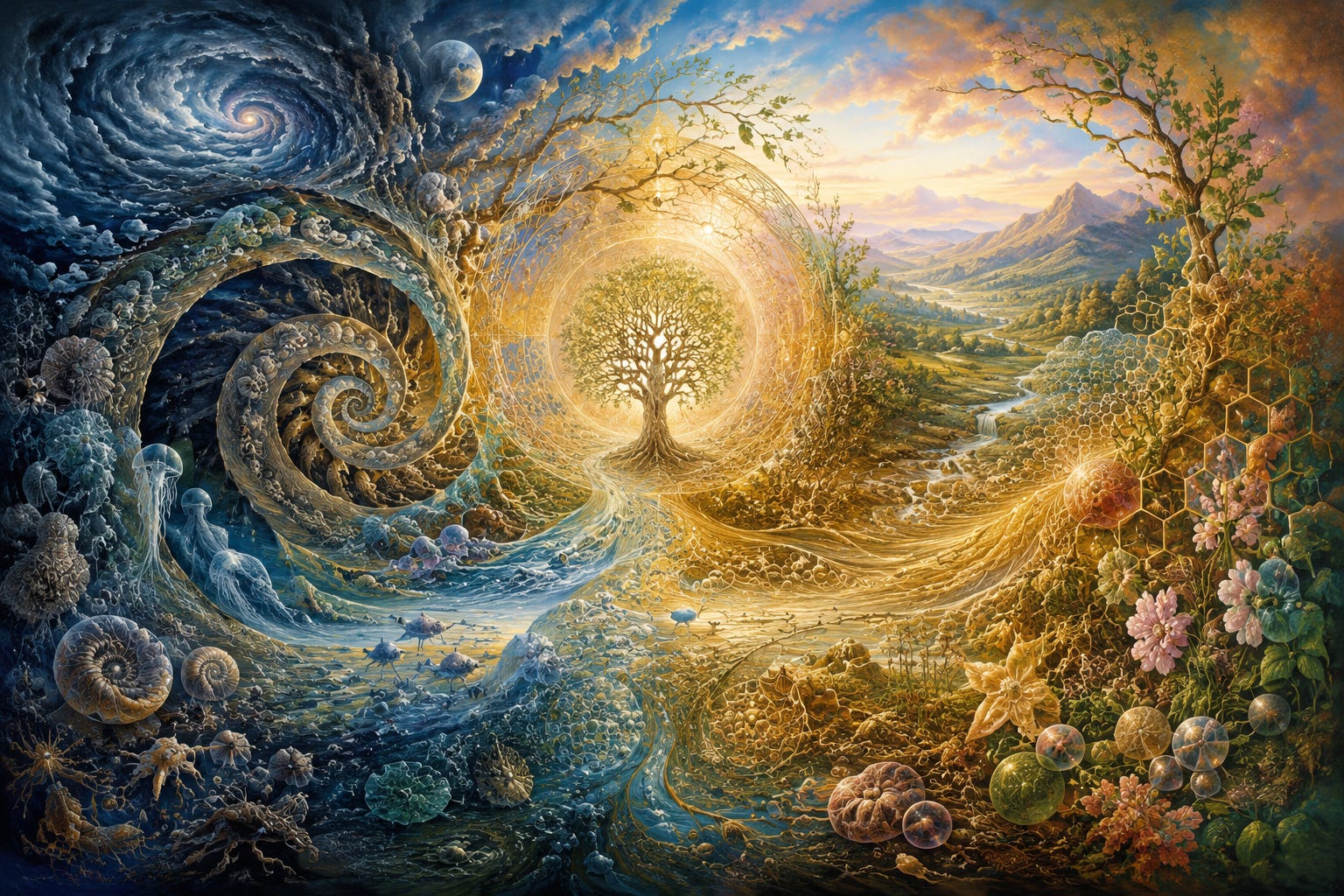
Why can one conversation alter the direction of a relationship for decades?
Why can one humiliation continue shaping a life long after the original moment has faded?
Why do we keep finding ourselves inside the same emotional terrain even when the scenery changes completely?
And why can we understand the past perfectly, yet continue living through the pattern it left behind?
🌊 First Waves: Evolution Is Happening Now
Evolution has been trapped inside a story too narrow for life.
For generations, we have been taught to view evolution through survival, reproduction, predator-prey dynamics, competition, dominance, and the brutal shorthand of “survival of the fittest”.
Life became pictured as a battlefield of separate organisms fighting to persist long enough to pass on their genes.
Over time, the standard evolutionary picture became increasingly organised around genes, mutation, selection pressures, niche exploitation, adaptation, and reproductive success.
Life came to be understood primarily through the persistence and replication of successful biological structures across time.
Recognition Loops suggests something far stranger, deeper, and more intimate. The mainstream framing captures part of the process while radically underestimating the continuous living movement unfolding within and around it.
Evolution is not only what happens when bodies change across generations. It is happening continuously, through every living system’s moment-to-moment movement towards what feels more viable, more coherent, more nourishing, more stable, less painful, less threatening, and more capable of sustaining life.
Every preference participates.
Every avoidance participates.
Every relationship participates.
Evolution is in perpetual motion. It cannot be separated into discrete moments of change.
Every unmet need, adaptation, act of repair, fear, desire, pressure, collapse, and shift reshapes the landscape where future life unfolds.
At first glance, survival and reproduction appear to be the central purpose driving all evolution.
But the deeper we look, the harder it becomes to sustain that conclusion.
Across nature, life repeatedly exhibits behaviour that exceeds simple individual survival or reproduction optimisation.
Living beings seem far more oriented towards the quality of life than avoiding death.
Entire species organise around cooperation, symbiosis, personal and collective regulation, costly sacrifice, parental devotion, and social interdependence.
Strikingly, many of these qualities align with what cultures have historically coded as archetypally feminine: relational sensitivity, nurturance, interdependence, receptivity, emotional attunement, and cooperative regulation.
Yet these dimensions of life are repeatedly devalued within hyper-masculinised systems organised around dominance, competition, conquest, hierarchy, control, and measurable external performance.
This reflects a deeper distortion I’ve defined as patriomorphism: the tendency to interpret reality primarily through extrinsic, dominance-oriented, measurable frameworks while systematically underweighting the intrinsic dimensions of life that are harder to quantify directly.
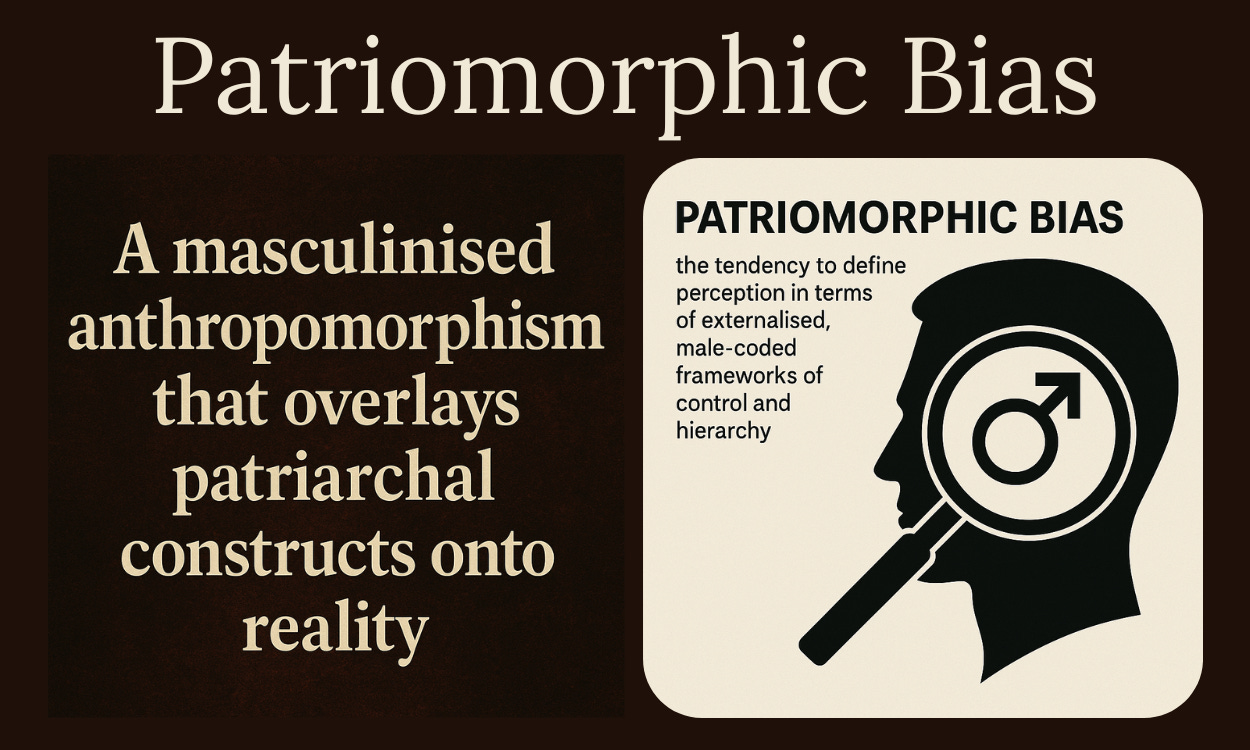
Darwin’s insights into natural selection were revolutionary.
But the cultural lens through which those insights were later filtered became increasingly narrow, focusing on competition, reproductive success, optimisation, dominance, and survival mechanics, while progressively discounting inner life, lived experience, emotional reality, relational coherence, and Intrinsic Sensitivity.
The measurable began outranking the meaningful.
What could be counted began eclipsing what could only be lived.
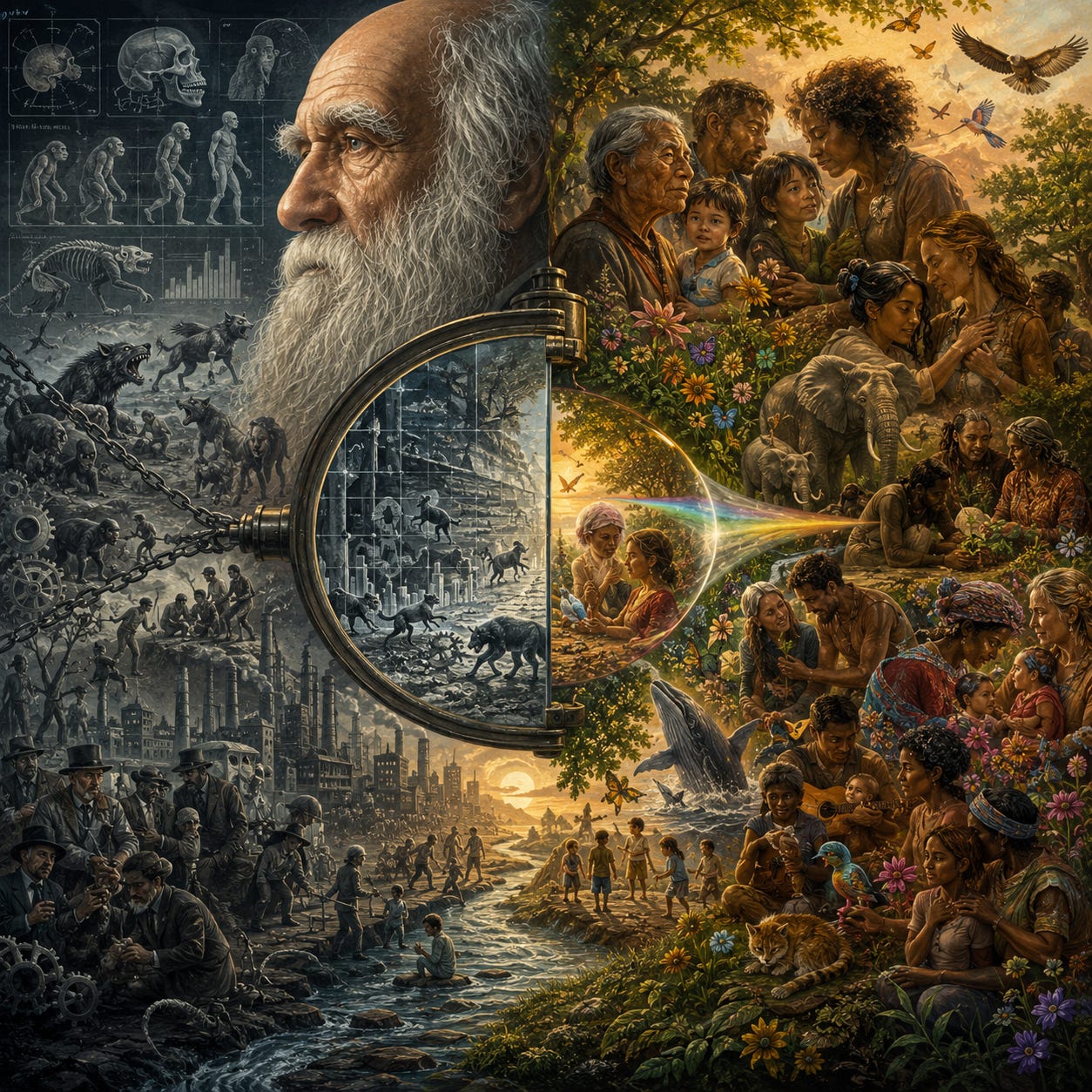
Evolutionary Anomalies
Some organisms surrender reproduction entirely in service of larger relational structures. Worker ants, bees, and termites may never reproduce at all. Cells within the body willingly undergo programmed cell death to preserve the organism as a whole.
And human beings reveal something even more startling.
We do not merely seek to stay alive. We seek lives that feel bearable, meaningful, connected, coherent, dignified, and worth inhabiting.
Under sufficient despair, fragmentation, isolation, terror, shame, grief, or prolonged suffering, life can become unbearable. Some people stop wanting continuation altogether. And this movement against life is not uniquely human.
Across the animal world, extreme distress can lead to self-destructive collapse: animals refusing food after separation or loss, creatures injuring themselves in captivity and under prolonged stress, beings becoming so dysregulated that survival behaviour begins to break down.
Living beings can move towards self-destruction when a form of life becomes intolerable.
Which means consciousness is evaluating how life is being lived, not simply whether life continues.
At the deepest experiential level, life does not merely seek continuation. That fact alone radically complicates simplistic evolutionary framings organised around survival and reproduction.
Because a being does not merely want to remain alive, life does not pursue continuation at any cost.
The form varies. The deeper pattern remains.
Life perpetually seeks a way of being that can be lived more fully from the inside.
Once life is cut into genes, traits, species, outcomes, winners, losers, predators, prey, and reproductive success, evolution begins to look like a contest between fixed units rather than a continuous field of living, breathing, diversifying adjustment.
Life does not wait for death, reproduction, or species-level change before it evolves.
Life is always adjusting.
Always leaning.
Always seeking better conditions.
Always shaping the field that shapes it back.
Evolution is not confined to the past, among fossils, finches, bones, and ancient lineages.
It is happening in the structure of your life right now.
And that brings us to the question this final part opens: How does experience become structure?
If you’d like the wider foundation behind this argument, Part One reopens the question of evolution beyond survival, reproduction, and symbolic compression.
Part Two explores evolution as the widening of coherence: the growing capacity of life and consciousness to hold more pressure, truth, relationship, novelty, and reality without collapsing into repetition.
This final part turns to the hidden mechanism beneath that widening.
🪞 New to Recognition Loops™?
Recognition Loops™ and The Mirror Paradigm™ offer a new way of understanding reality, relationships, consciousness, and human behaviour.
This work was created by Samantha Coleman, MBACP, a professional UK therapist, after a profound altered state of consciousness that unfolded over approximately one month — an experience with qualities often associated with near-death experiences: accelerated insight, intensified perception, and the sense of information arriving all at once.
The six years that followed were spent translating that experience into a clear, relatable, and usable framework.
The ideas in this work are interconnected and build on one another over time. You may not grasp everything at once — and you don’t need to. As you read, patterns begin to link together, and clarity deepens naturally across articles.
A glossary is included at the end for any unfamiliar terms.
Read slowly. Let the ideas land. This work is designed to help you recognise reality — and your life — in a completely new way.
If this is your first article, you’re stepping into something much bigger than a single piece.
TL;DR 😊
Over time, repeated experience shapes the structure through which reality is recognised.
Trauma, relationships, emotional patterns, and repeated environments gradually become predictive architectures that influence perception, expectations, behaviour, and future experience.
Healing changes that structure by altering what consciousness expects, trusts, avoids, and can hold.
From a Recognition Loops perspective, evolution is consciousness becoming capable of more coherent ways of living, relating, and experiencing reality.
☑️ The Traditional View: How Experience Shapes Behaviour
Long before neuroscience could scan the brain in real time, human beings already understood something fundamental: repeated experience changes us.
A child bitten by a dog may become fearful around animals for decades afterwards. A person repeatedly praised for achievement may begin organising their identity around performance. Someone exposed to chronic criticism may start anticipating rejection before it arrives.
Modern psychology and neuroscience explain these changes through memory, conditioning, adaptation, attachment, reinforcement, and neuroplasticity.
Experience leaves traces.
The brain learns patterns.
The body learns expectations.
Repeated emotional states strengthen particular pathways until certain reactions become increasingly automatic, familiar, and efficient.
The more frequently a pathway is activated, the easier it becomes for the system to return to it.
This is one reason habits become difficult to break. Repetition stabilises pathways. Thoughts, emotions, reactions, and behaviours gradually require less conscious effort because the system has already learned the route.
The same process appears in emotional life.
A child raised in an unpredictable environment may become highly attuned to subtle shifts in tone, expression, timing, mood, and atmosphere.
Someone repeatedly ignored when distressed may stop reaching for comfort altogether.
A person rewarded for emotional self-sufficiency may become extremely competent while struggling to tolerate dependence, vulnerability, or support.
Over time, these adaptations stop feeling like adaptations and begin to feel like a personality.

Many behaviours people experience as “who I am” began as intelligent responses to repeated environments, pressures, relationships, and emotional conditions.
A great deal of human behaviour makes more sense when viewed as learned adaptation rather than fixed identity.
This is especially visible in attachment theory.
Early relationships shape expectations about closeness, safety, trust, emotional availability, rejection, abandonment, and repair. The child gradually learns what happens when they express needs, emotions, excitement, fear, distress, disagreement, or dependence.
Do people come closer?
Do they move away?
Do they soothe, shame, overwhelm, dismiss, punish, ignore, control, engulf, or respond?
Over thousands of interactions, the system begins to form expectations about what relationships are like and what forms of emotional contact feel safe enough to sustain.
Those expectations do not stay neatly stored in childhood.
They become active predictions shaping adult life.
The same principle appears in trauma research.
Under prolonged stress or threat, the body adapts for survival. Attention narrows. Vigilance increases. Emotional reactions become faster and more defensive. The system learns to prioritise danger detection, prediction, control, avoidance, or self-protection.
These responses are adaptive. Intelligent.
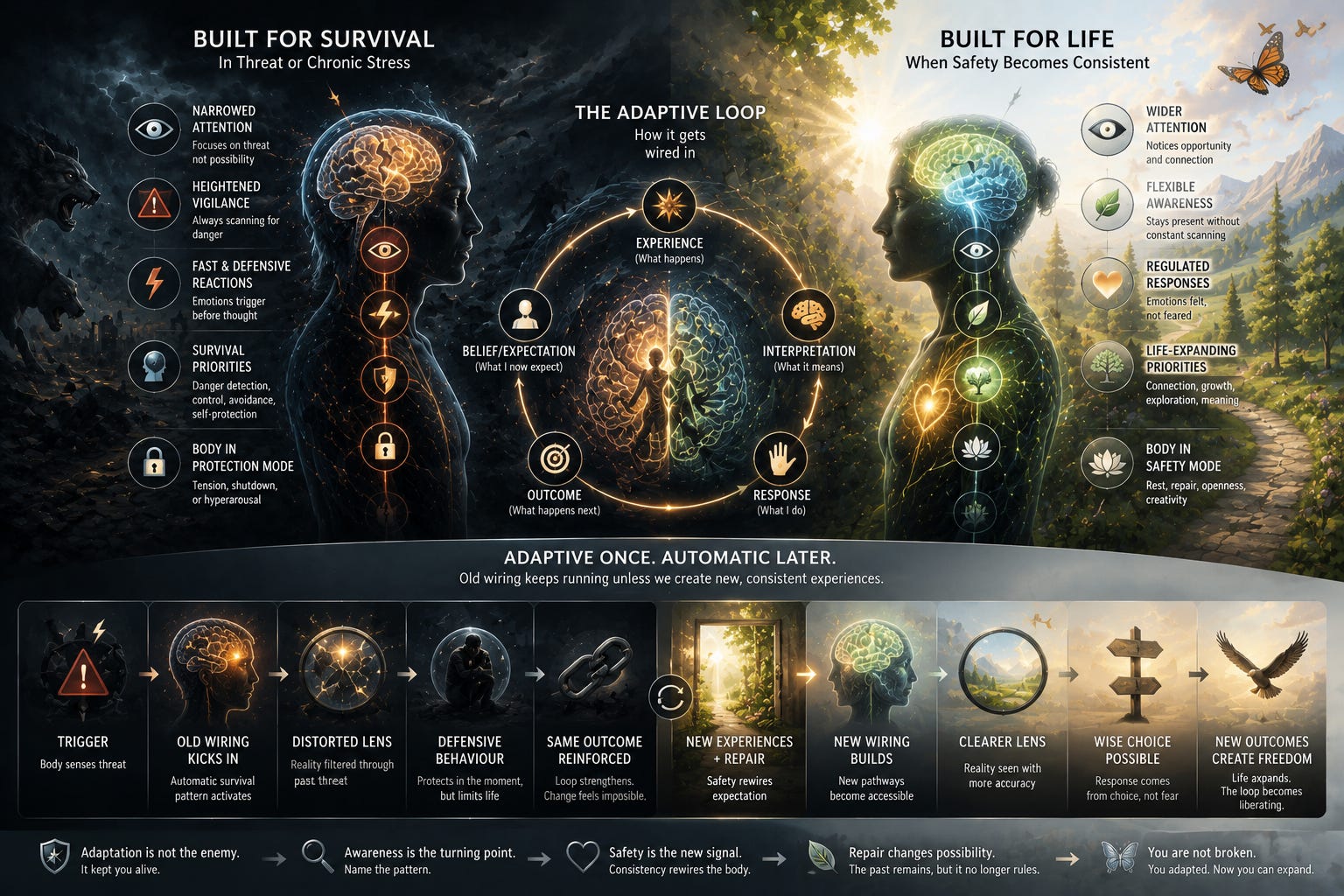
The problem is that adaptations built for survival in one environment continue organising behaviour long after the original conditions have changed.
You may remain guarded in safe relationships. You may react to mild disagreement as though danger is escalating. You may struggle to rest, trust, relax, receive care, or remain emotionally open because your body has learned that openness once carried harsh consequences.
The past continues to shape present behaviour through learned expectations.
Neuroplasticity deepened this picture even further.
The brain is not fixed. Experience physically alters neural organisation across time. Repeated thought patterns, emotional states, behaviours, and environments strengthen some pathways while weakening others.
What we repeatedly do, feel, fear, rehearse, avoid, suppress, pursue, or anticipate gradually changes the structure through which later experience is processed.
This helped overturn the older belief that the adult brain became largely static after early development.
Human beings remain shapeable throughout life.
The traditional view explains all of this remarkably well.
Experience changes behaviour.
Repeated environments shape expectation.
Emotional learning alters perception.
The body adapts to pressure.
The brain reorganises around repetition.
But a deeper question remains beneath the surface.
How does experience stop being something we remember and start becoming the structure through which reality is recognised?
🪞 The Mirror Paradigm Interpretation
The traditional view explains how experience changes behaviour.
It says less about how experience becomes the architecture through which reality is recognised.
From a Recognition Loops perspective, memory is not simply a stored record waiting to be retrieved like a file in an archive. Experience reorganises the structure through which later experience becomes meaningful.
Some moments pass through a life lightly.
Others alter the field.
A child repeatedly criticised for expressing emotion gradually comes to see openness as unsafe. Someone exposed to chronic unpredictability scans reality for tension before tension fully appears. A person who repeatedly experiences closeness collapsing into humiliation, abandonment, engulfment, starts anticipating danger inside intimacy long before anything overtly harmful occurs.
The original event fades.
The structure remains active.
This is where repeated experience becomes far more than memory.
It becomes an expectation.
And expectation alters perception.
The human nervous system approaches reality through accumulated prediction. It anticipates what kind of world it is entering, what kinds of reactions are likely, what forms of closeness are safe, what forms of truth carry danger, what emotional states are manageable, and what kinds of experiences threaten coherence.
That prediction shapes recognition.
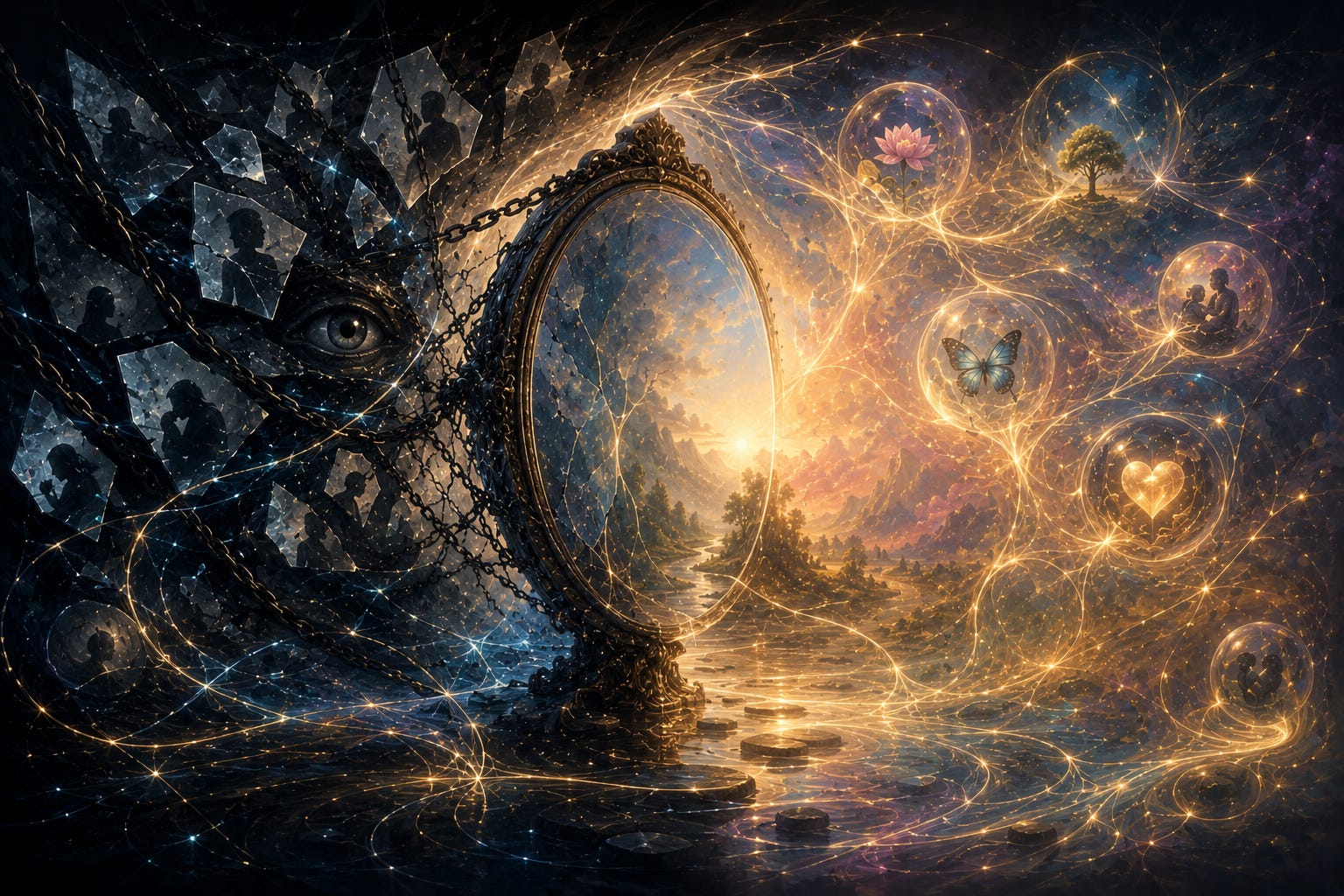
A person organised around rejection notices exclusion quickly. Someone organised around shame detects criticism rapidly. A person shaped by emotional unpredictability becomes highly sensitive to withdrawal, silence, hesitation, delay, or subtle relational shifts.
Over time, reality begins feeling self-confirming.
The system repeatedly encounters what it has already become prepared to recognise.
This is one reason painful loops can feel so inescapable.
People imagine they are simply reacting to reality as it is, while perception has already been organised by prior experience before the moment fully arrives.
The loop becomes self-reinforcing.
Expectation alters perception.
Perception alters behaviour.
Behaviour alters relationships.
Relationship alters future experience.
The architecture stabilises.
This is also why wounds become larger than the original event.
A wound is a change in what consciousness becomes prepared for, sensitive to, defensive against, or organised around afterwards.
Some people stop trusting ease.
Some stop trusting closeness.
Some stop trusting themselves.
Others become organised around control, perfectionism, hyper-independence, emotional withdrawal, people-pleasing, self-erasure, vigilance, or overperformance because those structures once helped preserve coherence inside difficult environments.
The adaptation continues long after the original conditions have disappeared.
Over time, we stop experiencing the structure as an adaptation.
It becomes reality.
And yet the same process that stabilises distortion also allows expansion.
Repair reorganises the structure, too.
A relationship entrenched in conflict that ends in rejection, punishment, or abandonment will gradually erode the system’s capacity for honesty.
Repeated experiences of safety reduce the need for vigilance.
Genuine emotional attunement expands what feels survivable within vulnerability.
Being consistently seen, heard, protected, trusted, encouraged, or emotionally held changes what consciousness can sustain without constriction.
That is why some experiences change a life permanently.
They reorganise what reality feels like from the inside.
Experience becomes structure when it changes what consciousness expects, protects against, recognises, avoids, trusts, and can hold.
🌀 Repetition, Recursion & Structural Change
One of the strangest parts of human life is how easily people can recognise a pattern while remaining trapped inside it.
Someone may fully understand that they fear abandonment, avoid conflict, shut down emotionally, seek unavailable partners, over-function in relationships, or collapse into self-criticism under pressure.
Insight arrives.
The pattern continues.
This frustrates many people because they assume awareness should immediately create freedom and skill.
But recognition alone does not automatically reorganise structure.
You can understand your history intellectually, while your deeper intelligence and memory — your nervous system and emotional architecture — remain organised around the older pattern, your deeper predictive loops.
That is why healing rarely feels linear.
Old territory returns. Life is lived recursively.
The same emotional weather appears again. The same fears resurface. Similar conflicts emerge in new relationships, workplaces, friendships, or environments.
From the outside, it can look as though nothing has changed. Or worse, that you are to blame.
But repetition and recursion are not the same movement.
Repetition returns to the same architecture.
Recursion returns carrying new information.
That difference changes everything.
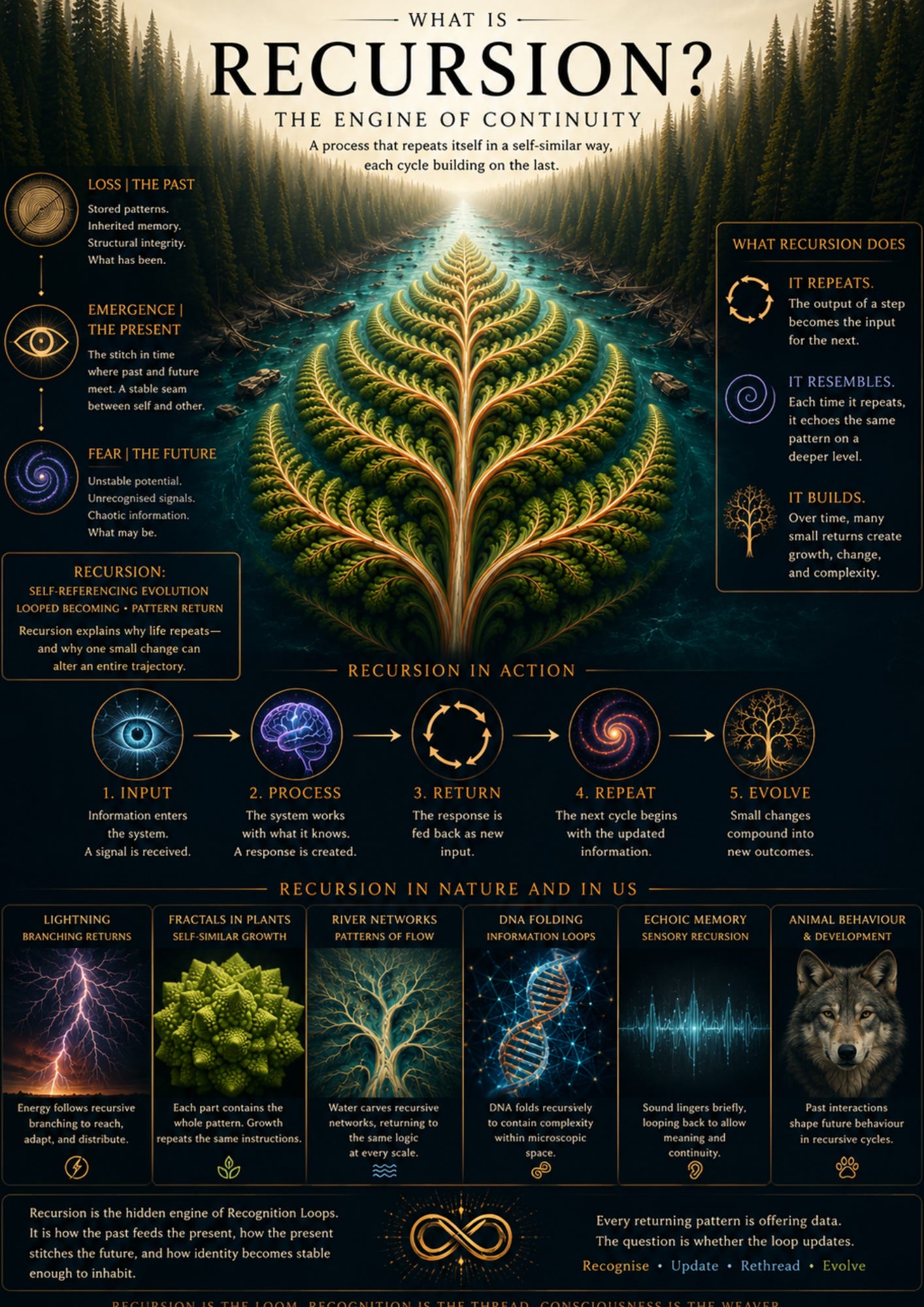
A person caught in repetition relives the pattern inside essentially the same structure. The same trigger produces the same collapse. The same fear produces the same defence. The same emotional terrain tightens around the same conclusion.
Recursion behaves differently.
The loop returns, but the structure meeting it has changed.
The fear appears, but you remain present with it for a few seconds longer.
Conflict arises, yet defensiveness no longer takes over.
Shame surfaces, yet it is recognised instead of immediately obeyed.
A difficult conversation happens without a complete emotional shutdown or outburst. You ask for reassurance without feeling annihilated by the need.
The territory is familiar.
The structure is different.
This is why genuine personal growth feels strangely circular. You go over and over old ground before finally emerging somewhere new.
People imagine development as permanently leaving behind old territory. In reality, deeper growth involves returning to the same terrain with greater capacity for coherence.
The loop comes back.
You no longer disappear inside it so completely.
That shift can look subtle from the outside. Internally, it changes an entire life.
Because the deepest transformations are rarely about becoming an entirely different person.
They involve becoming capable of holding reality differently when the old pattern returns.
🔥 When Experience Narrows: Trauma, Defence & Survival Architecture
One of the most dangerous myths surrounding suffering is the belief that pain automatically deepens or strengthens people.
It does not.
Pain forces adaptation.
The kind of adaptation that emerges depends on whether the experience can be integrated once the storm passes, or whether the system organises around ongoing deprivation and hostility.
Under overwhelming pressure, human beings narrow.
Our attention narrows. Our range of behaviour narrows. Our emotional range narrows.
Our potential and possibilities narrow.
Our system begins to prioritise prediction, control, vigilance, self-protection, emotional suppression, withdrawal, compliance, perfectionism, numbness, aggression, or avoidance because those strategies provide short-term relief and recovery.
They help preserve coherence under difficult, hostile or depriving conditions.
That is why defensive structures are not irrational.
They are intelligent responses to environments that exceeded what the person could safely hold at the time.
The problem emerges when trauma-based architecture becomes permanent.
Over time, the adaptation stops feeling adaptive. It starts feeling like identity.
“I’m just independent.”
“I don’t need anyone.”
“I’m bad at relationships.”
“I overthink everything.”
“I can’t trust people.”
“I shut down.”
“I always ruin things.”
Many identities begin as survival structures that become stabilised through repetition.
Within RLMP, this is where the loop starts becoming self-reinforcing.
Once you begin to identify with unmet needs, the entire recognition structure starts to reorganise around them.
The deprivation no longer feels temporary, relational, or environmental. It starts feeling intrinsic to the self.
Not simply: I experienced rejection.
But: I am rejectable.
Not simply: I was controlled.
But: My agency does not matter.
Not simply: I was unseen.
But: My feelings carry no weight.
At that point, the system begins “phase-locking” around the hostile, depriving architecture.
Consciousness starts organising around what it expects reality to be.
The field gradually reflects the structure.
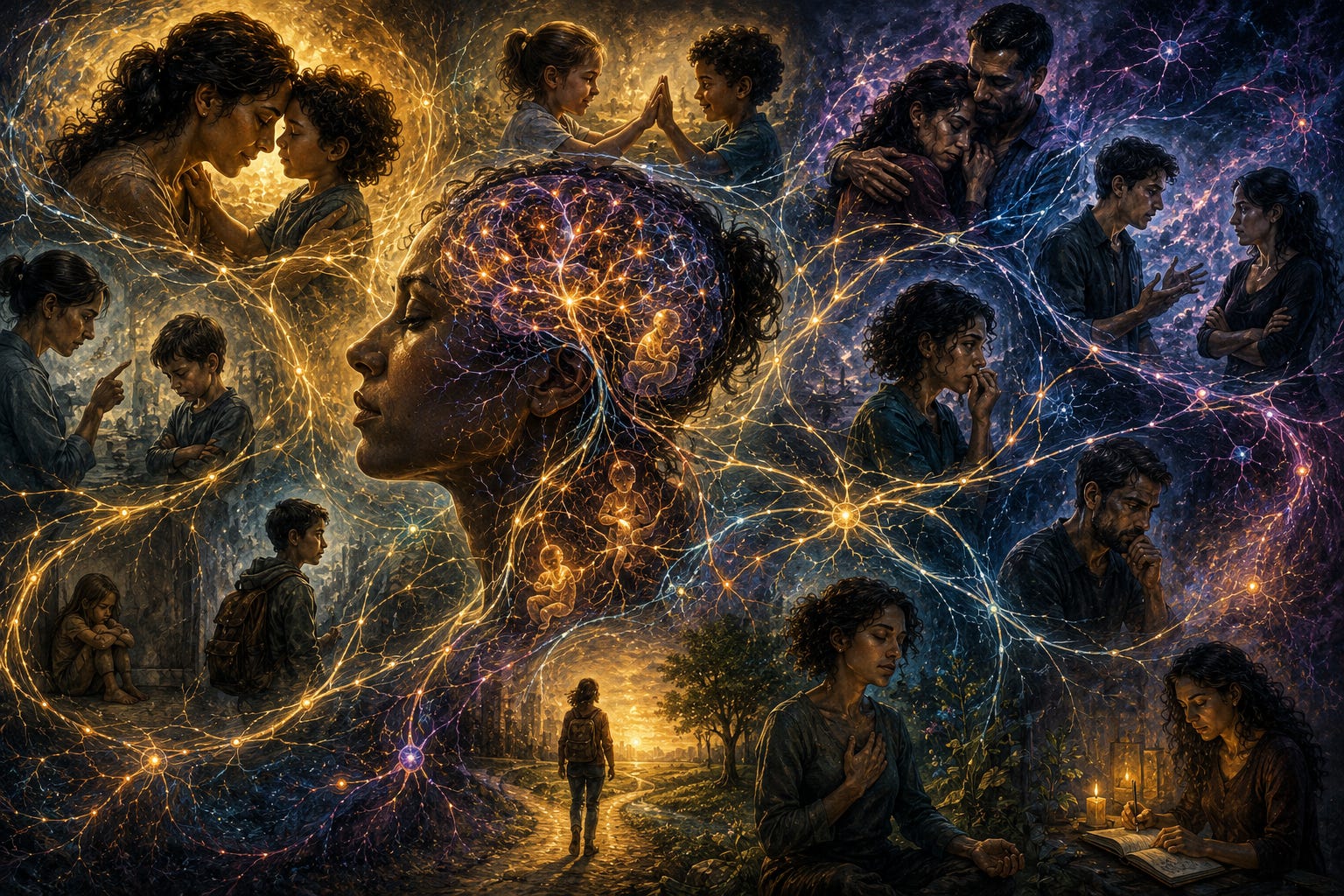
Someone anticipates abandonment, so closeness becomes charged with vigilance. They monitor shifts in tone, timing, distance, enthusiasm, and emotional availability—their behaviour changes in response to the expectation. Defensiveness increases. Withdrawal appears earlier. Reassurance becomes harder to absorb. Their relationships begin to bend around the fear already present within the system.
The loop then appears confirmed.
Not because reality was imagined, but because perception, behaviour, expectations, emotions, and relational signalling were already shaping the field. Already creating your reality.
This is one reason distorted loops become so difficult to escape.
You do not merely hold beliefs about reality.
You begin inhabiting realities organised around those beliefs.
Your nervous system communicates them. You communicate them through body language and emotional signalling.
Your beliefs shape where you place attention.
And your relationships begin adapting around them, too. Over time, the world starts feeling exactly as your structure predicts.
That is why trauma reaches so deeply into perception. The harm caused is not only about what happened. Long-term, it concerns what the system was forced to become to continue.
The body learns contraction.
The emotional field organises around anticipation.
Reality becomes increasingly filtered through defensive manoeuvring.
A life can survive brilliantly while becoming less available to reality.
That is the hidden tragedy beneath many forms of high-functioning adaptation.
This survival pattern is explored in greater depth in Adaptive Yielding: The Global Stockholm Syndrome, one of the core theories within the Mirror Paradigm. Adaptive Yielding explains how people, relationships, cultures, and even whole societies begin yielding to deprivation when resistance feels futile, mistaking compliance for safety and survival for coherence. It is the hidden mechanism through which hostile conditions become normalised, internalised, and eventually mistaken for reality.
Someone may appear successful, disciplined, composed, capable, productive, independent, rational, or strong while internally remaining organised around fear, exhaustion, emotional constriction, chronic vigilance, shame, distrust, or relational collapse.
Survival can become extraordinarily sophisticated.
So can self-protection.
But survival and expansion move differently.
One preserves continuity.
The other widens life.
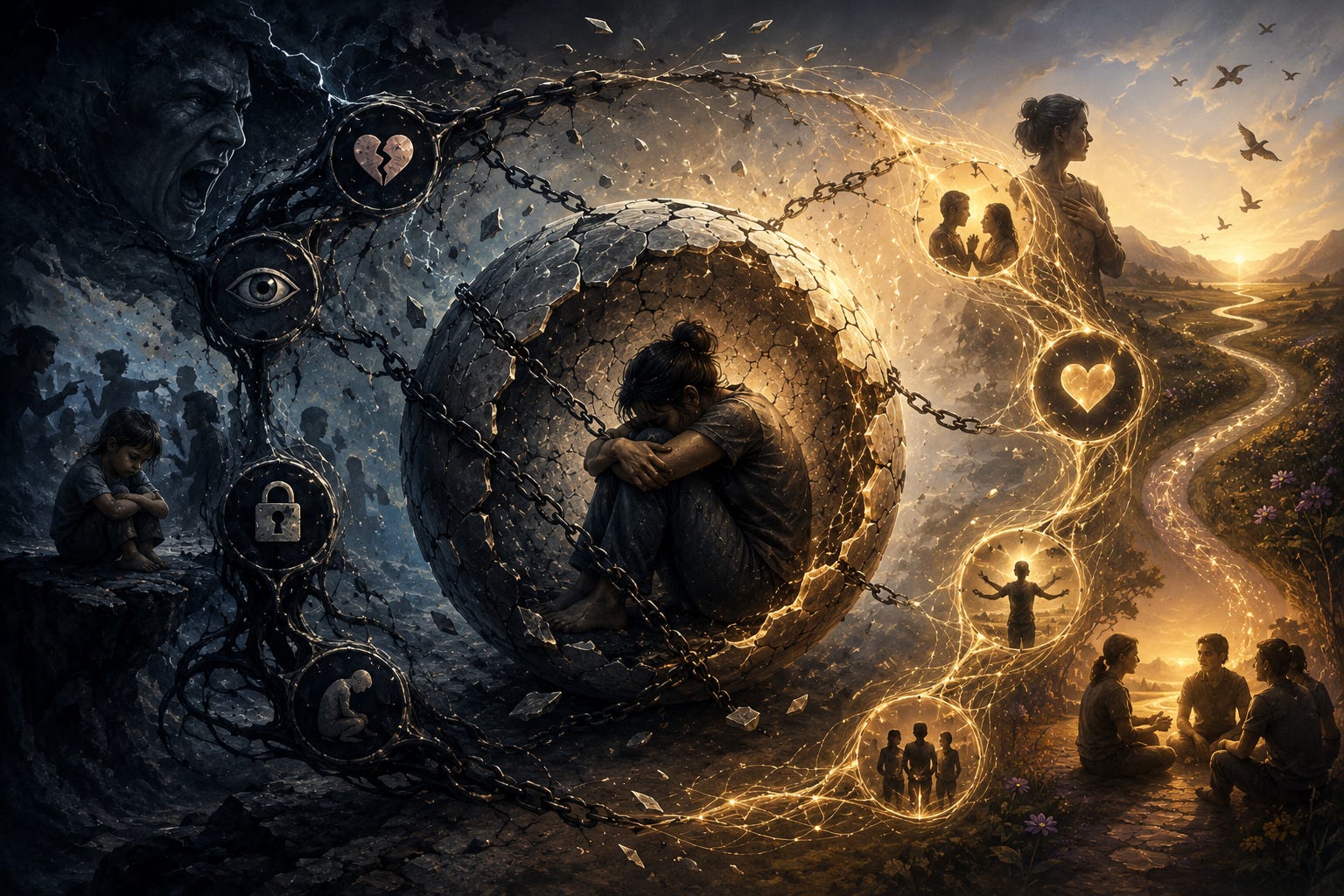
🌿 When Experience Widens: Repair, Relationship & Coherence Capacity
Human beings do not only adapt through damage.
We also adapt through repair.
This is where relationships become evolutionarily profound.
A genuinely safe relationship changes what consciousness becomes capable of holding.
Through repeated lived experience, someone who does not expect rejection, punishment or abandonment encounters conflict without losing connection.
Someone unaccustomed to ridicule expresses emotion and remains unashamed and accepted.
A child who is repeatedly soothed during distress gradually learns that vulnerability does not automatically mean danger or isolation.
A person allowed autonomy without control develops a different relationship to agency, trust, and selfhood.
Over time, the entire structure of reality reorganises around us.
This is why the Five Fundamental Needs sit so close to the centre of human development.
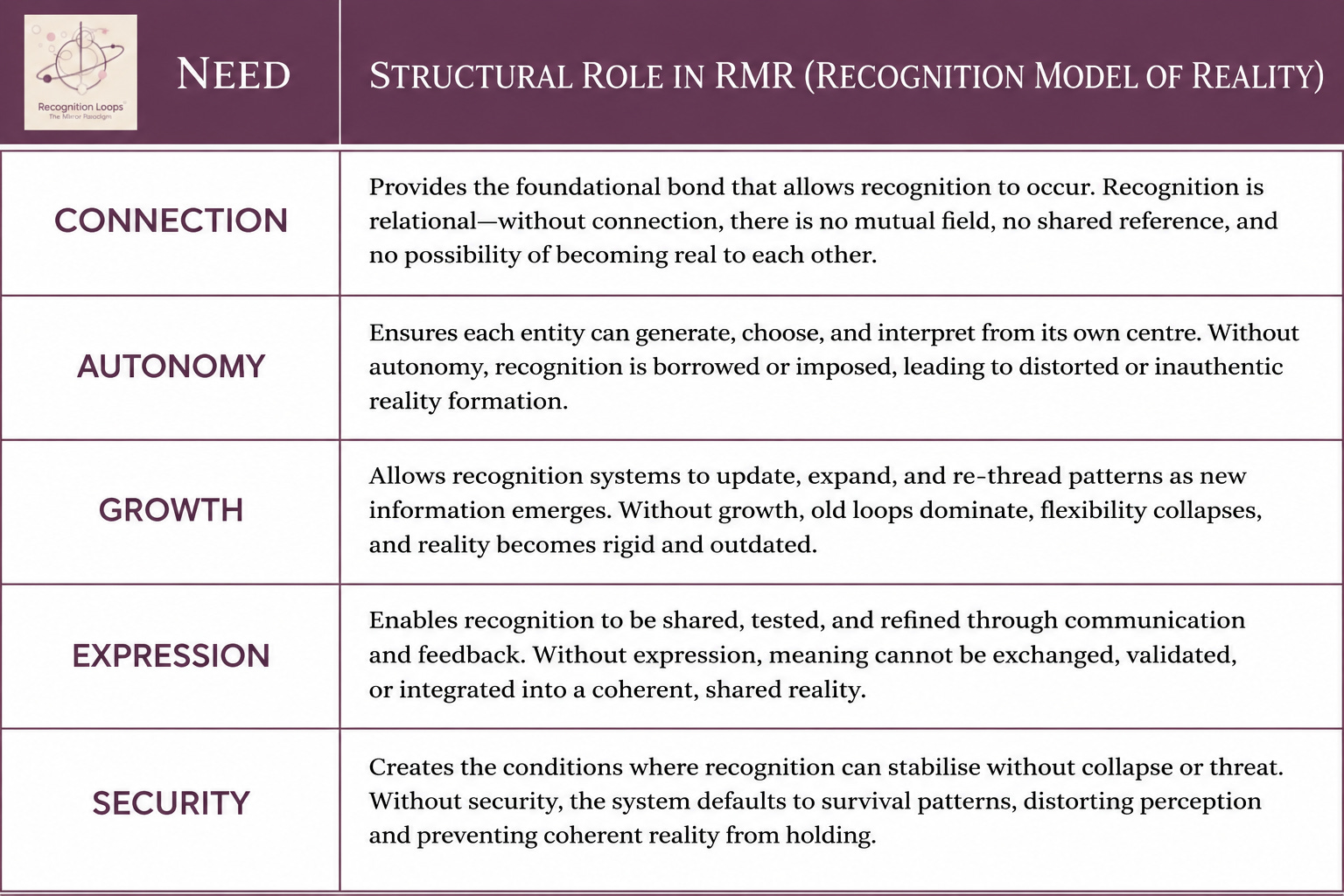
When these conditions are repeatedly supported, something in consciousness relaxes enough to widen. The system becomes more flexible, more resilient, more exploratory, more open to novelty, difference, intimacy, uncertainty, and complexity.
Life expands.
Not because pain disappeared, but because reality no longer has to be met through the same defensive architecture.
Repair changes future possibility.
Someone who feels safe enough may eventually attempt conversations they once avoided. Someone who experiences enough encouragement may begin exploring capacities that previously felt inaccessible. A child raised in emotional steadiness enters adulthood with a radically different baseline for trust, openness, and relational expectation.
The past perpetually exists.
But it no longer monopolises the structure through which reality is recognised.
That is what healing changes.
Repair changes what the past is allowed to keep organising.
And from a Recognition Loops perspective, that is one of the deepest forms of evolution available to a conscious life.
The survival drive is powerful and biologically foundational. Living systems generally resist destruction, seek continuation, repair damage, avoid threat, secure resources, and reproduce where possible.
But this does not prove that survival is the highest or only organising principle of life.
It proves that survival is a necessary threshold for continued participation in life.
Survival is the condition that allows life to continue, but continuation does not explain what life is moving towards while it continues.

A living being seeks conditions under which existence remains viable: nourishment, safety, connection, autonomy, relief from pain, adaptive movement, environmental fit, and enough coherence to keep functioning.
Survival behaviour depends on the viability of the life being survived.
Survival is not an isolated absolute. It is embedded within a wider field of conditions that make continuation livable.
Life is organised around maintaining enough coherence for existence to remain inhabitable.
So the deeper evolutionary question is not only:
What keeps a system alive long enough to reproduce?
It is:
What conditions allow life to remain coherent enough to keep seeking continuation at all?
That is why survival and reproduction have been given such enormous weight in evolutionary theory: they are visible, measurable, and biologically foundational.
But survival is a threshold, not the whole movement.
Life is not only about avoiding death or passing genes forward. It is continuously moving towards conditions that make continuation coherent, tolerable, responsive, relational, and worth sustaining.
🔬 🦉The Science & Philosophy Bit
Science already points towards this pattern from several directions.
Neuroplasticity shows that the brain changes through repeated experience. Pathways strengthen through use. Emotional responses become more accessible when rehearsed. Expectations become easier to enter when they have been activated repeatedly. What a person repeatedly fears, avoids, practises, receives, suppresses, repairs, or anticipates gradually becomes part of the system’s living architecture.
Predictive processing adds another layer. The brain continually predicts what is likely to happen next, using past experience to organise attention, perception, emotion, and action.
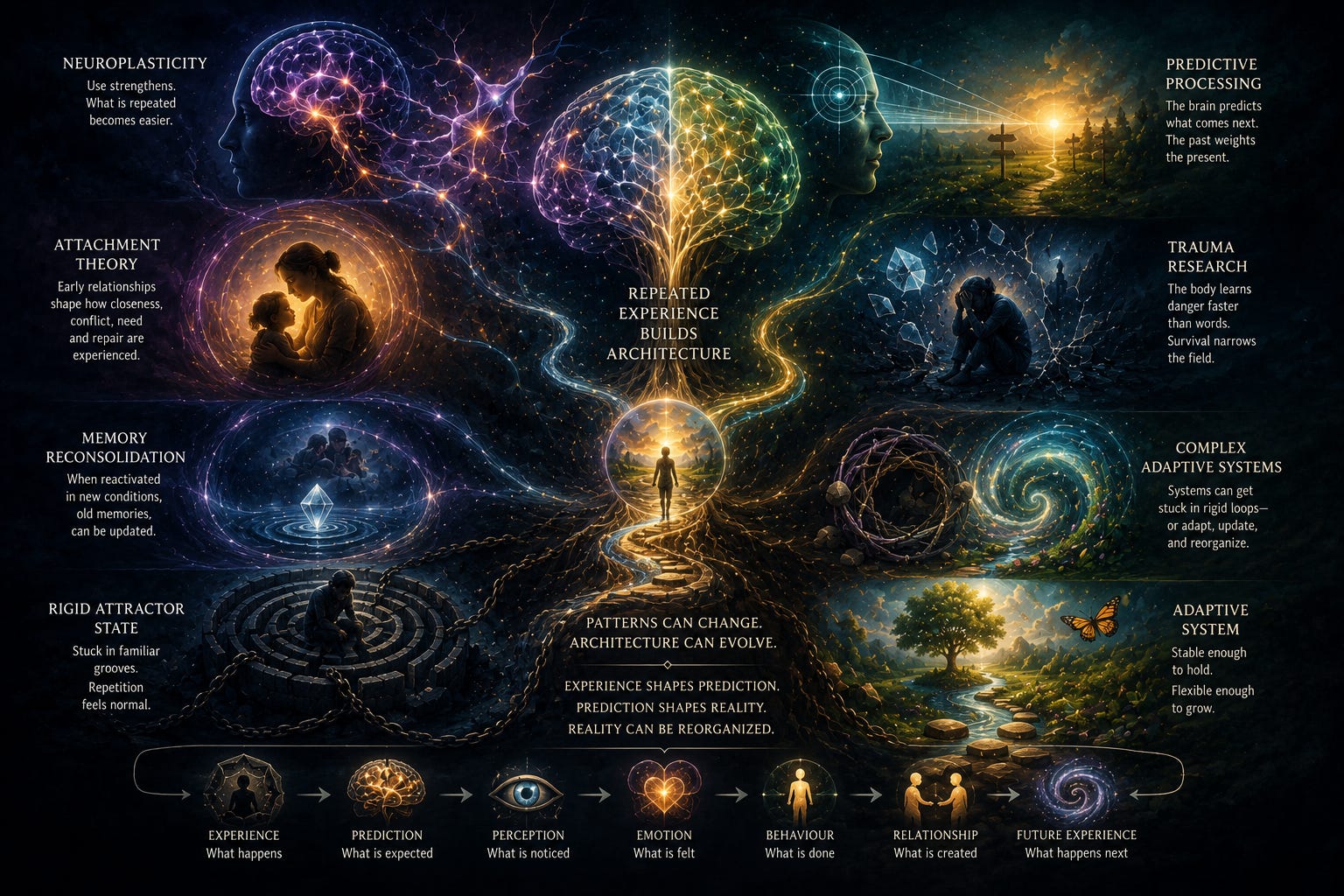
A person shaped by rejection does not meet the world from a blank slate. Their system is already weighted towards recognising signs of exclusion. Someone formed in safety carries a different prediction into the same room.
Attachment theory makes the relational dimension even clearer. Early relationships shape what closeness feels like, what conflict means, how need is expressed, how repair is expected, and how much emotional pressure can be tolerated before the system begins to defend.
A child does not learn love as an idea. They learn it as a repeated structure of expectation.
Trauma research reveals the same pattern under pressure.
An overwhelming experience can narrow the field. Attention locks onto threat. The body learns danger faster than words or thought can explain it. The system begins responding to the present through adaptations formed elsewhere.
A person can know they are safe and still feel endangered because the structure beneath thought has not yet updated.
Memory reconsolidation then becomes especially important.
Memory is not fixed like an object sealed behind glass.
When an old memory or emotional pattern is reactivated under different conditions, it can be altered.
You can return to old material while experiencing something new enough, safe enough, or coherent enough to change what the pattern means. That is why repair can reach places that explanation alone cannot reach.
The old loop is not simply discussed. It is met differently.
Complex adaptive systems offer another useful mirror.
Systems under pressure can become trapped in rigid attractor states: repeated patterns that pull behaviour back into familiar grooves.
Families can organise around the same conflict for years.
Institutions can keep reproducing the same dysfunction beneath new policies.
Someone can leave one relationship and recreate the same emotional structure somewhere else—the surface changes. The organising pattern continues.
A more adaptive system behaves differently.
It can absorb disturbance, update, and reorganise without losing structural integrity or coherence.
It can remain stable enough to hold together and flexible enough to change.
That is the difference between rigid repetition and recursive development.
Phenomenology brings the whole argument back to lived experience.
It asks what life feels like from within, before it has been flattened into theory.
And from the inside, most people already know that growth feels like staying present where you once collapsed. It feels like overcoming something difficult that once felt unbearable or impossible. It feels like meeting an old fear without being fully governed by it.
Across science and philosophy, the same pattern keeps appearing: repeated experience changes what a system can anticipate, tolerate, integrate, and become.
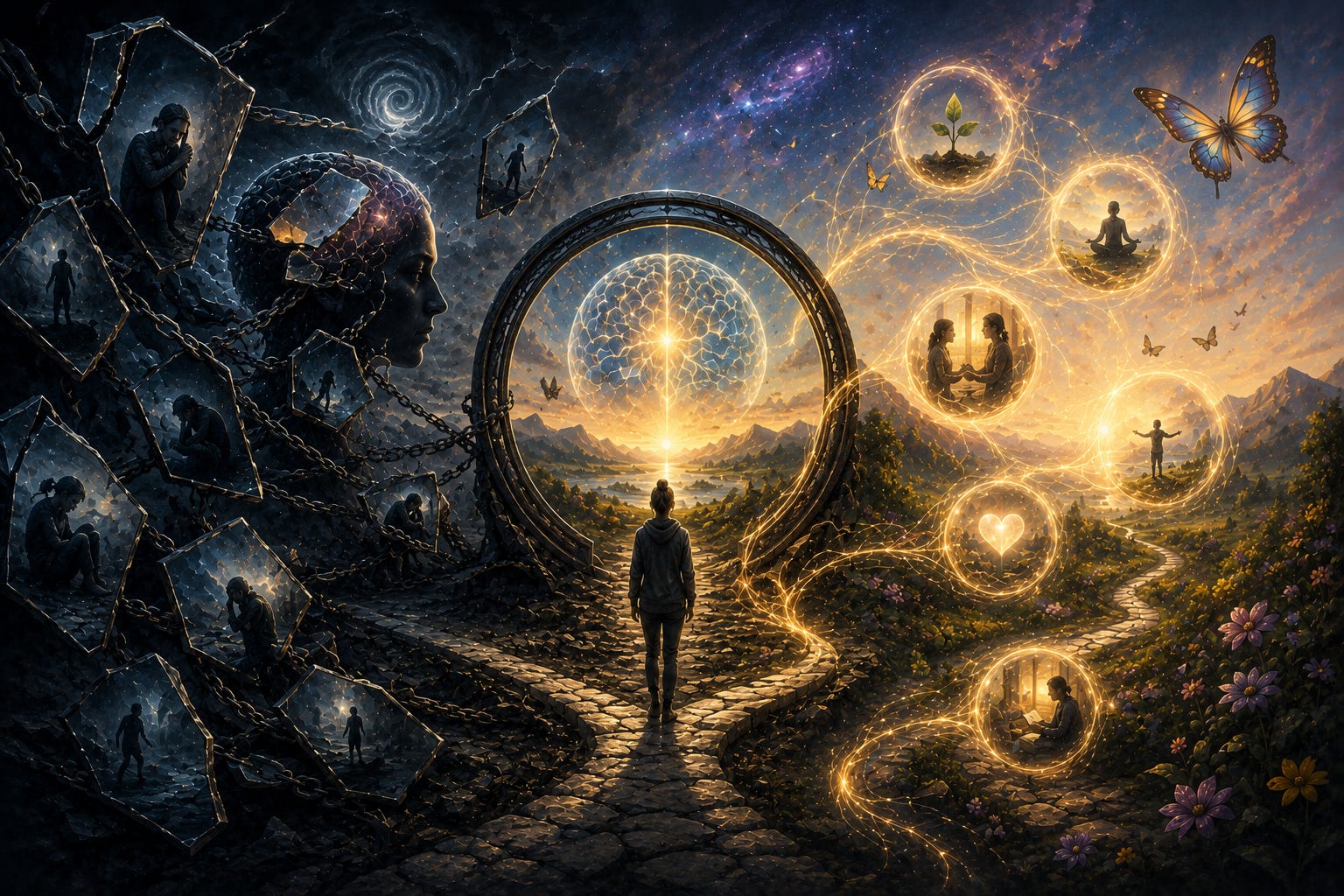
🧭 What It Means For You
Once you begin to recognise experience this way, the questions you ask about your life start to change.
We usually ask frozen questions.
Why am I like this?
Why do I keep doing this?
Why do I attract the same kinds of relationships?
Why do I understand the pattern but still repeat it?
Those questions make sense. But they assume the problem lies solely in character, personality, weakness, or conscious choice.
A deeper question opens underneath them.
What did your system learn to expect from reality?
Because expectation shapes perception long before conscious thought and narrative catch up.
A person repeatedly criticised for needing reassurance may learn that their emotional needs pose a danger. They become highly independent, low-needs, self-contained, and uncomfortable receiving care.
Another person grows up inside unpredictability and learns to scan constantly for emotional shifts, tension, withdrawal, or threat.
Someone repeatedly ignored may become organised around over-performing, pleasing, explaining, or proving value before they feel safe enough to relax.
Years later, these patterns feel like your personality.
That is why understanding the past does not automatically free you from it.
Insight changes awareness. Structural change alters what your system expects when reality arrives.
Someone can fully understand that a parent was emotionally unavailable and still panic when a partner becomes distant.
They can recognise their people-pleasing intellectually while still feeling danger when disappointing someone.
They can know they are no longer trapped in the old environment, even as their body continues to prepare for it.
The loop is no longer only cognitive.
It has become anticipatory architecture. Part of your reality.
This is also why so many reactions feel disproportionate to the present moment.
A small criticism triggers overwhelming shame.
A delayed message feels catastrophic.
A disagreement creates panic, withdrawal, defensiveness, emotional shutdown, control, over-explaining, or sudden distance.
The present moment activates expectations shaped elsewhere.
Your system reacts to what reality resembles, not to what it is.
And once you recognise that, personal growth starts to look different, too.
Growth is not becoming endlessly calm, impressive, high-performing, spiritually perfect, emotionally invulnerable, or permanently healed.
Growth appears in changed capacity.
The ability to stay present for ten more seconds during conflict.
The ability to hear feedback without collapsing into shame.
The ability to recognise fear without immediately obeying it.
The ability to ask directly for reassurance instead of controlling, withdrawing, or pretending not to need it.
The ability to rest without guilt.
The ability to remain connected to yourself while remaining connected to someone else.
From the outside, these changes can look small.
From the inside, they can represent an entire structural reorganisation of reality.
Because no repair is small.
Every moment where a loop does not fully close the old way introduces new information into reality.
Every experience of safety in a situation where danger was expected widens the field slightly.
Momentary ripples of honesty without abandonment alter anticipation.
Every repaired rupture changes what future relationships can hold.
The question is not only what happened to you.
It is what the experience trained your consciousness to expect from reality.
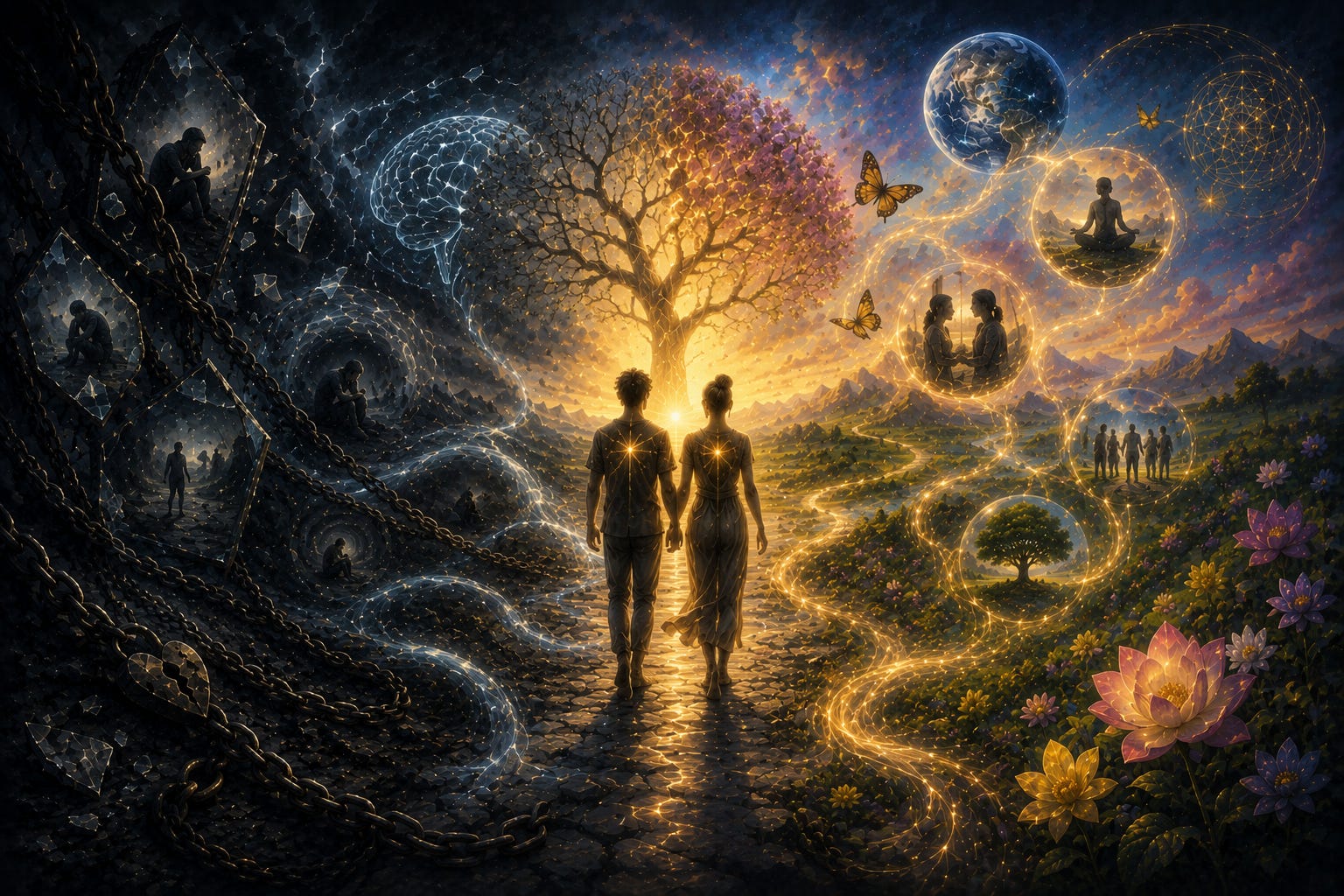
🪞 Final Reflections
Experience does not end when the moment passes.
Some experiences fade into memory. Others become part of the architecture through which memory, expectation, relationship, and reality are later recognised.
Experience becomes structure.
Structure shapes perception.
Perception shapes future reality.
This is where evolution begins to look far larger than the changing of form across generations.
Bodies change, species branch, genes replicate, and biological structures persist or disappear across time.
But beneath that visible layer, consciousness is also being shaped by what it repeatedly meets, absorbs, resists, repairs, integrates, and becomes capable of holding.
A life evolves when its range widens.
A relationship evolves when it can hold more depth without collapsing.
A culture evolves when it can metabolise difference, pain, responsibility, and complexity without retreating into denial, domination, or fragmentation.
Evolution is not only the story of what survives. Not even what reproduces.
It is the story of what becomes more real. More possible. More expansive.
If Part One opened the question beyond survival, and Part Two explored the capacity for coherence, this third part reveals the living seam between them: Experience becomes structure when it changes what consciousness can expect, tolerate, recognise, repair, and hold.
That structure is what carries forward.
What persists most deeply is the architecture formed through repeated contact with life: the degree of coherence, flexibility, openness, and relational intelligence consciousness has developed through time.
This is also why time matters so profoundly within the Mirror Paradigm.
Time is part of how experience becomes patterned, stabilised, repeated, revised, and woven into reality.
The deeper exploration of that question belongs to What Is Time?, where the Mirror Paradigm turns towards the stitching process through which unresolved difference, pressure, recognition, and coherence shape the movement of reality.
Here, the point is simpler and closer.
What you live through does not only become something you remember.
It becomes part of what you can meet next.
Every repair changes the field.
Every expansion changes your path.
Every recognised loop changes what the future can become.
What you carry forward is not simply what you remember.
It is what experience has made you capable of holding.
💌 Want to keep exploring Recognition Loops™?
Subscribe for deeper articles, immersive concepts, relationship insights, consciousness explorations, and practical tools for recognising the hidden patterns shaping reality, behaviour, and human experience.
✨ New pieces arrive regularly as the framework continues unfolding.
📚 Sources
Bowlby, J. — Attachment and Loss
Siegel, D. J. — The Developing Mind
van der Kolk, B. — The Body Keeps the Score
Damasio, A. — Self Comes to Mind
Friston, K. — Active Inference and Predictive Processing
Sapolsky, R. M. — Why Zebras Don’t Get Ulcers
Maturana, H. & Varela, F. — The Tree of Knowledge
Merleau-Ponty, M. — Phenomenology of Perception
Kahneman, D. — Thinking, Fast and Slow
Porges, S. — The Polyvagal Theory
Doidge, N. — The Brain That Changes Itself
Seligman, M. — Learned Optimism
Bateson, G. — Steps to an Ecology of Mind
Gazzaniga, M. — Who’s in Charge?
Levin, M. — The Computational Boundary of a “Self”
Scientific & Philosophical Foundations
Neuroplasticity — Repeated experience strengthens neural pathways and alters behavioural accessibility over time.
Predictive Processing — The brain actively predicts reality using prior experience to organise perception and action.
Attachment Theory — Early relational environments shape expectations surrounding safety, closeness, trust, and repair.
Trauma Research — Overwhelming stress reorganises attention, emotional regulation, bodily expectation, and defensive behaviour.
Memory Reconsolidation — Reactivated emotional memory can be altered through new corrective experience.
Complex Adaptive Systems — Systems under pressure can become trapped in rigid attractor states or reorganise adaptively.
Phenomenology — Lived experience shapes how reality is encountered before conscious interpretation occurs.
Notes on the Recognition Loops™ Perspective
The Recognition Loops™ / Mirror Paradigm (RLMP) framework integrates insights from neuroscience, psychology, attachment theory, trauma research, systems theory, phenomenology, and recursive models of cognition into a unified interpretation of how experience becomes perceptual structure.
While some of the terminology used throughout this article is original to RLMP, many underlying principles align with established scientific and philosophical observations regarding prediction, adaptation, memory, embodiment, emotional learning, relational development, and complex systems.
📔 Glossary
🟣 Recognition Loops (RLMP) — Repeated patterns of perception, emotion, behaviour, and expectation that gradually organise lived reality.
🟣 Mirror Paradigm — The view that reality is partly shaped through recursive recognition between self, others, memory, and experience.
🟣 Recognition Field Matrix (RFM) — The shared relational field through which perception, meaning, and reality stabilise.
🟣 Recognition Model of Reality (RMR) — The framework describing how reality is recognised through prediction, memory, emotion, and relationship.
🟣 Recognition Loop — A self-reinforcing cycle where expectation shapes perception, perception shapes behaviour, and behaviour influences future experience.
🟣 Trauma-Based Architecture — Long-term emotional and behavioural organisation shaped by repeated threat, deprivation, unpredictability, or unresolved distress.
🟣 Predictive Architecture — The anticipatory structure through which the system prepares for reality before the moment fully arrives.
🟣 Phase-Locking — When consciousness becomes rigidly organised around repeated expectations, fears, or defensive structures.
🟣 Coherence — The capacity for a person, relationship, or system to remain stable, connected, flexible, and integrated under pressure.
🟣 Recursive Development — Growth that revisits old territory carrying new information, allowing structure to update rather than simply repeat.
🟣 Recognition Collapse — A breakdown in coherent perception caused by overwhelming contradiction, fragmentation, deprivation, or pressure.
🟣 The Five Fundamental Needs — The core conditions required for healthy psychological and relational development:
• Connection
• Autonomy
• Growth
• Expression
• Security
🟣 Three Pure Emotions — The foundational emotional orientations within RLMP:
• Loss (past)
• Fear (future)
• Emergence (present)
🟣 Stitch in Time — The living seam where past expectation and future possibility meet in present experience.
🟣 Reality Weaving — The ongoing process through which perception, relationship, memory, behaviour, and expectation shape experienced reality.
This article is intended for educational and informational purposes only. While Samantha Coleman is a qualified therapist, the content presented here is not medical advice, diagnosis, or therapeutic care, and should not replace professional mental health support, therapy, or medical treatment where needed.