

What Is Consciousness?
& Why it Can't be Reduced to Brain Function, Memory, or Performance

🌊 First Waves
When memory fails, do you disappear with it?
When something is felt before it can be explained, what is doing the feeling?
Why does a world emerge from within in the first place?
Consciousness is one of the most frequently invoked words in philosophy, psychology, spirituality, and science, yet it remains one of the least understood.
We speak about it as though its meaning were obvious, but that confidence is misleading.
The term gets stretched across too many different things at once: wakefulness, self-awareness, intelligence, responsiveness, subjectivity, inner life, personhood, and even soul.
The result is a conversation that looks far more settled than it appears.
We argue about where consciousness comes from, whether animals possess richer forms of it than we acknowledge, whether it can be measured, whether it is an illusion, whether it survives death, whether it can be explained through information-processing, or whether it points beyond mechanism altogether.
We grapple with the idea of uploading minds into machines. Or machines becoming conscious.
Despite the rhetoric, the central mystery remains strangely untouched.
How Does Anything Become Experienced?
How does reality become felt, known, registered, and lived? How and why does a world appear from the inside?
Many things in the universe adapt to environmental changes and continue to function without conscious awareness. So, why did it arise?
That is the real pressure point.
The deepest mystery of consciousness is not simply that organisms are complex, adaptive, intelligent, or capable of extraordinary forms of behaviour. It’s that experience is happening.
There is a point of view. There is a felt world. It feels like something to be yourself. To experience life from within.
That keeps slipping past reduction.
We describe the surrounding machinery and mistake it for the main event. It’s like mistaking the map for the traveller.
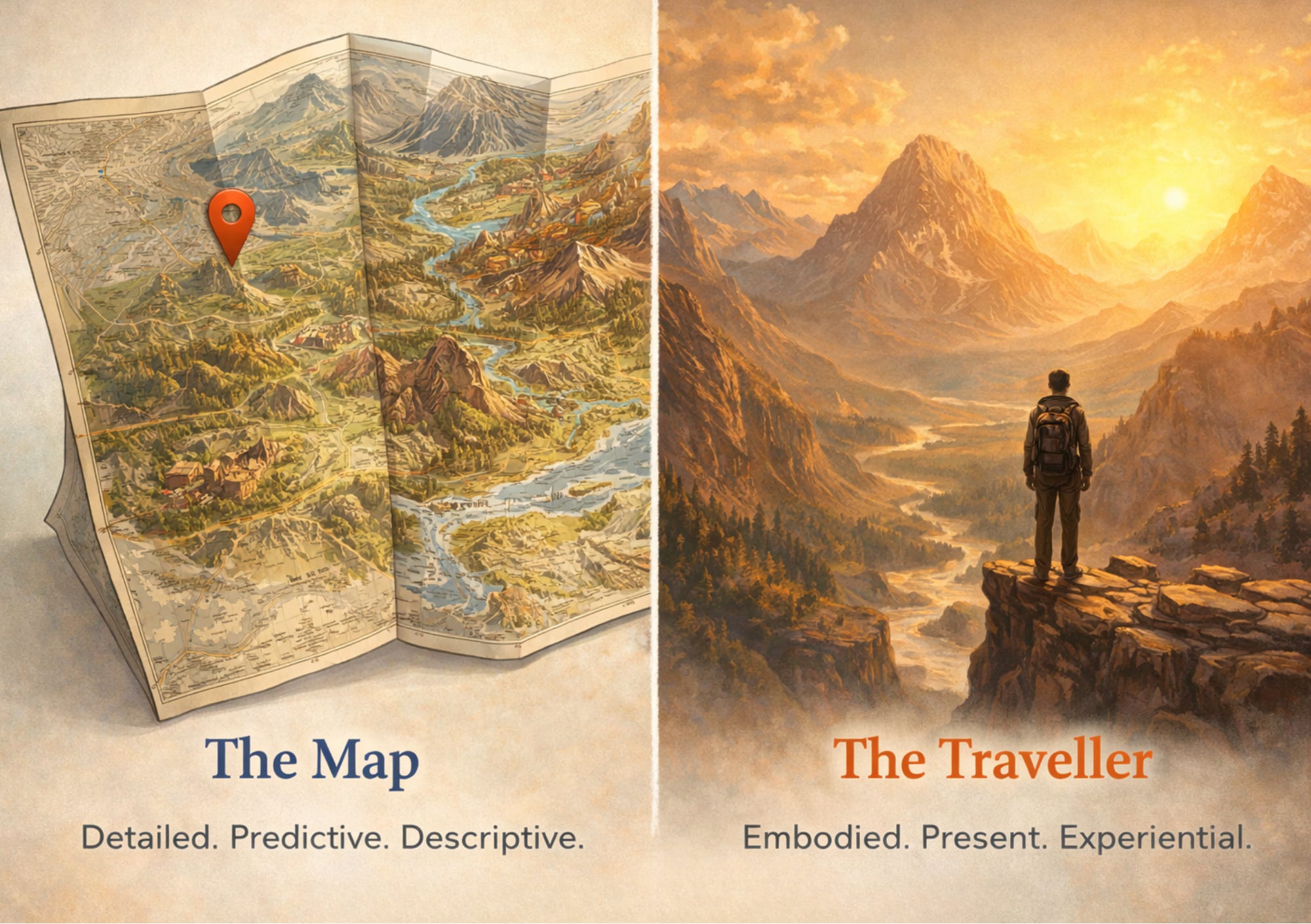
Thought, memory, and intelligence are clear parts of consciousness, along with wakefulness, brain activity, self-awareness, information, behaviour, and performance. Yet none of these explains why we experience reality from the inside.
The brain can be described, memory explored, and behaviour measured. Patterns can be modelled. Information can be stored, transmitted, compressed, and reproduced.
The central question remains exactly as before: what connection does any of this have to the reason we experience life from within?
We keep substituting the accompaniments of consciousness for the thing itself.
We confuse the archive with the experiencer, the output with awareness, and prediction with presence.
Recognition Loops views consciousness through a new mirror, revealing the same reflections from another angle.
Consciousness is not identical to memory, intelligence, information, the adult self we know best, or outward performance, no matter how sophisticated that personhood becomes.
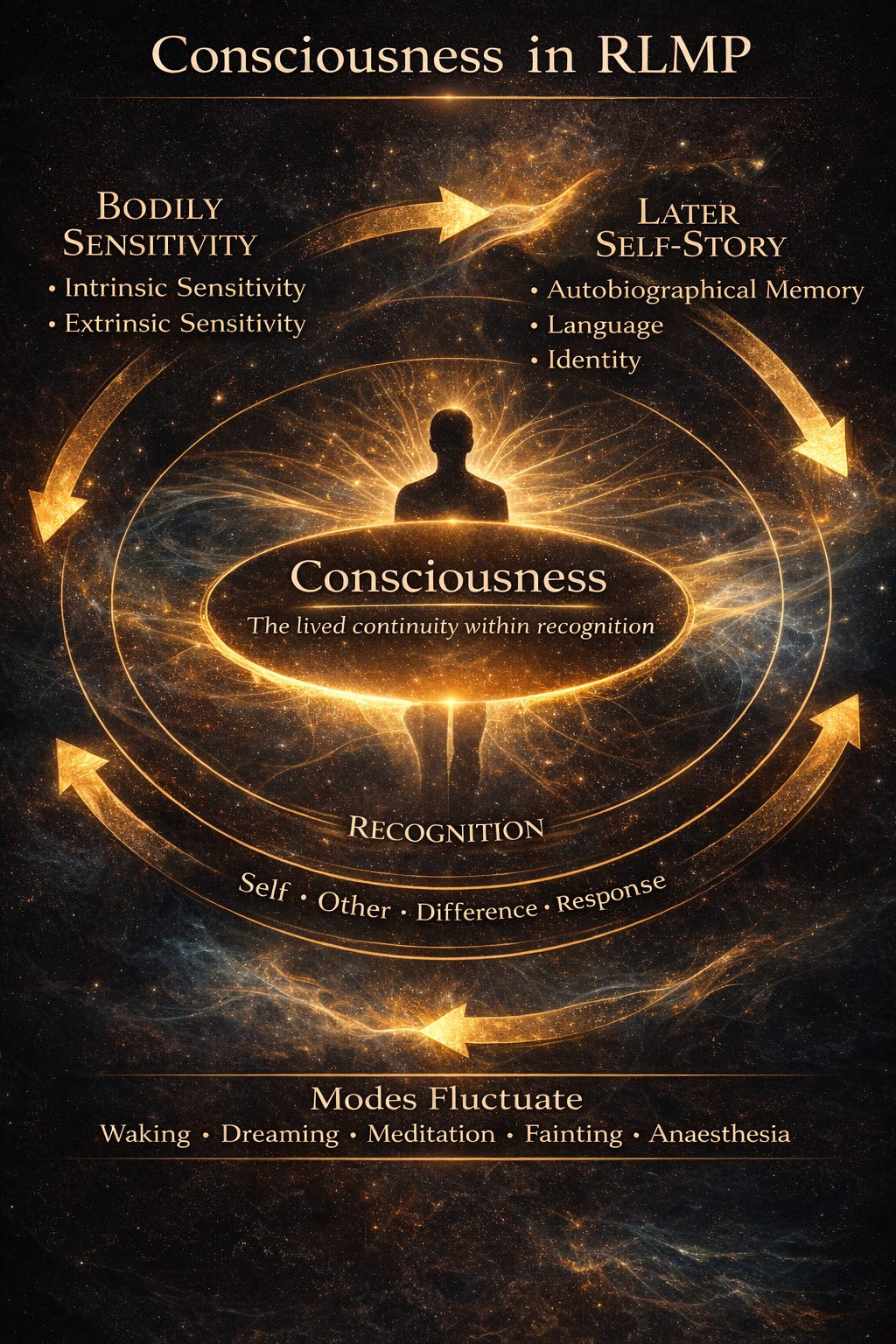
In the Recognition Loops Mirror Paradigm (RLMP), consciousness is the lived continuity of recognition through which self, other, and world become experienceable from within.
Once that distinction is clear, much of the confusion begins to dissolve.
If you’d like the structural hinge beneath this article, read What Is Recursion? It explains how continuity persists through return, feedback, and re-entry rather than simple repetition.
☑️ The Traditional View
In mainstream science, consciousness is typically understood as subjective experience: the fact that there is something it’s like to see, hear, feel, think, remember, imagine, or be awake.
From there, the dominant assumption is that consciousness arises from organised brain activity.
Researchers distinguish between two related questions.
The first concerns whether consciousness is present at all, as in wakefulness rather than coma or dreamless sleep. The second concerns what the organism is conscious of: the contents of experience.
At this level, the traditional view gives us a great deal of insight.
When the brain is injured, it can affect consciousness in many ways. Changes might occur in perception, memory, mood, speech, attention, and self-control, and even in personality. Consciousness is deeply tied to the body, the nervous system, and brain activity — that connection is undeniable.
Mainstream research has moved away from the older idea of a single “consciousness centre” in the brain.
The picture now is more distributed and dynamic, especially around thalamocortical processes. Scientists increasingly understand consciousness as arising through shifting communication across brain networks, particularly between the thalamus and cortex. These interactions appear to help shape both whether consciousness is present at all and what, specifically, enters awareness.
Different regions contribute different aspects of conscious content, and the overall picture is far more sophisticated than earlier, simpler models allowed.
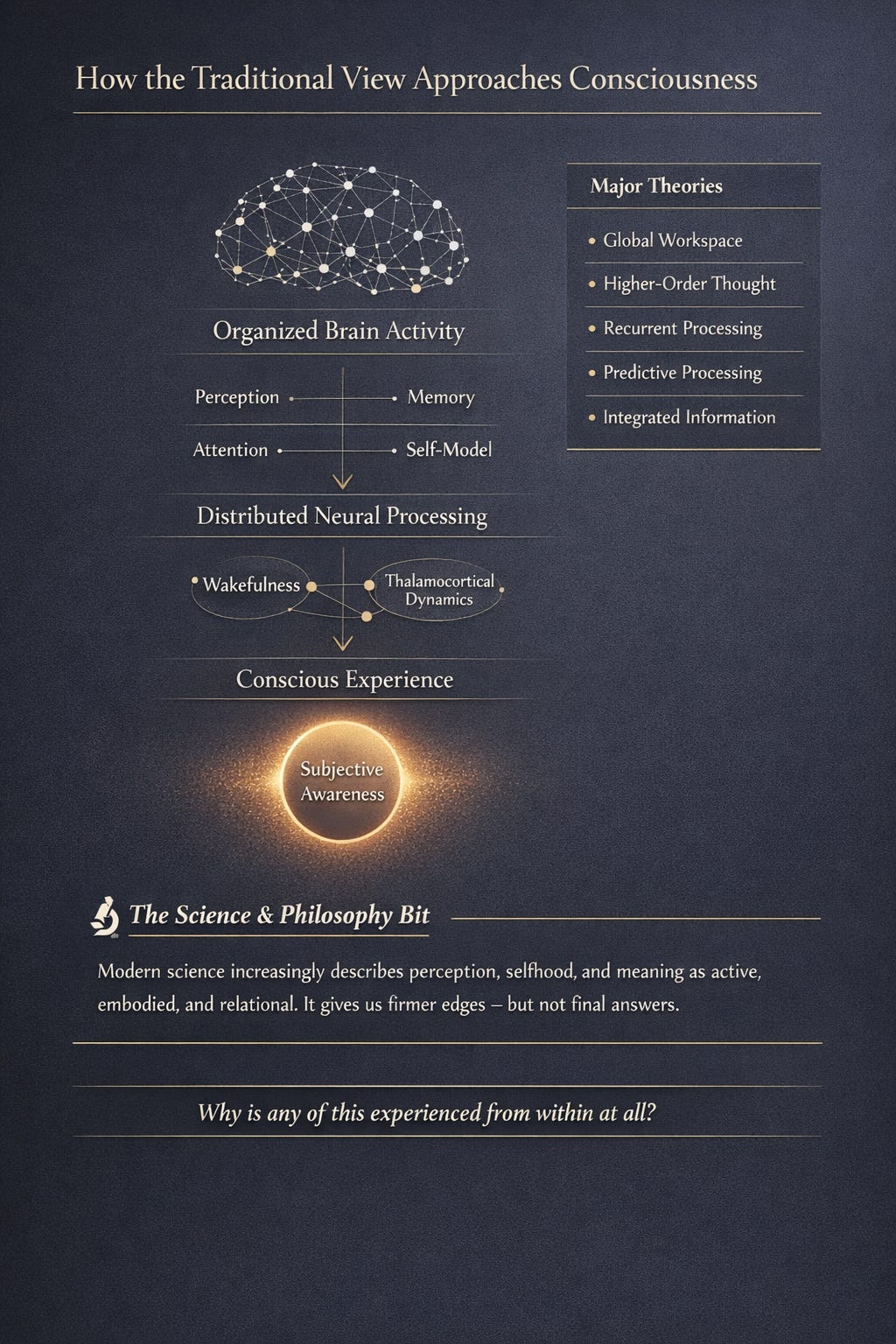
The traditional view still lacks a single settled theory of consciousness.
Some argue that a mental state becomes conscious when information is made globally available across the brain. Others emphasise higher-order awareness, recurrent feedback, predictive modelling, or integrated information.
The most serious contemporary work is less about pretending the mystery has been solved and more about narrowing mechanisms, testing rival models, and seeing which claims survive experimental pressure.
The prevailing mainstream view holds that human consciousness is closely linked to organised brain activity. Advancements continue to enhance the mapping of neural conditions underlying experience, differentiate conscious from unconscious processing, and deepen the understanding of the systems at play.
What it has not done is close the deeper question of exactly how brain activity becomes subjective experience, or why there is anything it is like to be such a system in the first place.
Mainstream science has become far more precise about the machinery associated with consciousness. But it has not yet arrived at a complete account.
🪞 The Mirror Paradigm Interpretation: Where Recognition Loops Begin
Mainstream science begins by asking what mechanisms accompany consciousness. RLMP starts with the simple fact that experience is already present.
Before we theorise, map, model, or measure its correlates, something is already being lived.
Consciousness isn’t a hidden object waiting to be found somewhere inside the machinery. It’s the deeper lived continuity through which a world becomes experienceable from within.
RLMP on consciousness, in brief:
Consciousness comes before the narrated self: Selfhood is a later local organisation within consciousness, not its source.
Memory is not the experiencer: A gap in recall isn’t automatically a gap in consciousness.
Information, intelligence, and performance are accompaniments: There’s a firm line between what a system can do and what it is like to be.
Replication does not settle the question of continuity: Preserving patterns does not resolve whether the same first-person continuity endures.
Reality is continually rewoven into perceptual coherence through the process of lived recognition: Consciousness is not just inside the world. It’s part of what makes a world appear in the first place.
Consciousness Before the Story of You
Consciousness is not another feature of reality.
It’s the lived continuity of recognition through which self, other, and environment become an internal world.
A newborn has no autobiography, polished identity, or self-narrative. So what, then, is already present?
A scent, a song, or another person can evoke deep emotion and move us before any conscious explanation arises.
Where, then, does that recognition come from? And why do we experience the world as felt from within at all?
Recognition arrives before representation. Narratives emerge only once conscious awareness becomes shareable.
Before you explain anything to yourself, experience is already happening.
You hear a sound and turn. The tension hits before you can name it. You wake from a dream already immersed in a world you haven’t yet shaped into words. You fall for some people and not for others, without quite knowing why.
The explanations come later. Life happens first.
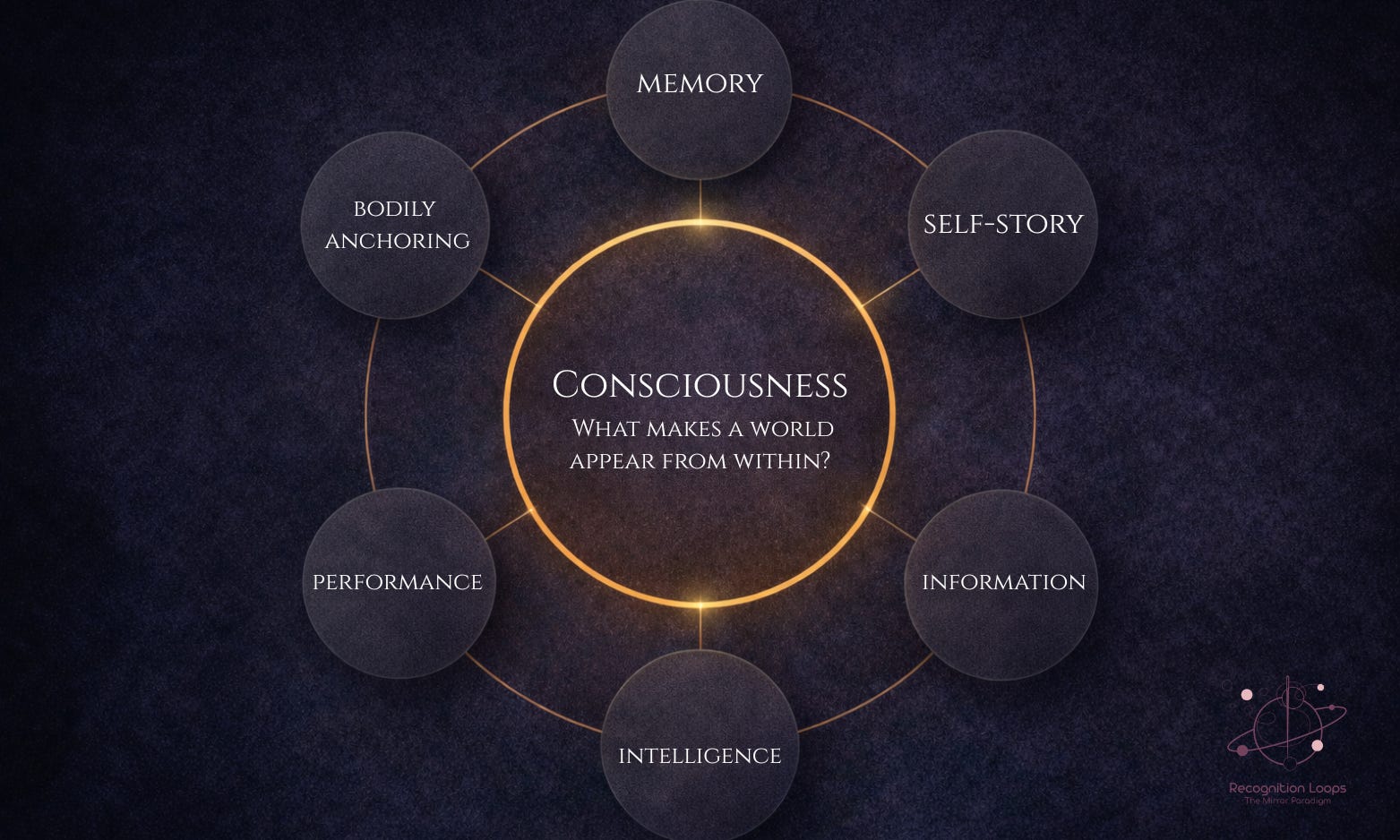
Matter may stabilise, memory may organise, information may circulate, intelligence may manage, performance may imitate. Consciousness is what makes any of that lived.
Modern culture keeps collapsing distinctions, confusing the narrated self with consciousness, the map with the process, and the outward signs of awareness with awareness itself.
In RLMP, consciousness is relational from the beginning. It is not a sealed private object locked inside our heads.
It’s the living continuity through which recognition closes: self and other, difference and response, world and re-entry, continuity and meaningful experience.
The self is then built from within that field.
The Self Is Real, But It Comes Later
What feels like a stable “you” is real.
It has continuity, character, memory, style, wounds, habits, preferences, loyalties, fears, and dreams. But those are not your deepest layers. They are not consciousness itself.
“You” came later, as a local organisation within consciousness: a recognition thread repeatedly re-stitched through memory, perception, relation, expectation, and response.
Identity is real, but it isn’t the ground of awareness.
One of the clearest clues appears at the beginning of life. A newborn is conscious long before they possess stable autobiographical memory, a developed self-concept, or a linguistic identity.
Awareness is already there, but the localised self is not.
We’re taught to link consciousness with the adult personality we know best—the voice in our head, the stories we remember, the familiar mix of traits and preferences.
We get so accustomed to this later setup that we start believing it’s the whole story. But none of those things is the source of your conscious awareness.
The adult human self is one way consciousness becomes locally structured. It’s one of awareness’s more elaborate stabilisations, shaped through relationship, language, memory, embodiment, and repeated recognition over time.
But consciousness comes first. The narrated self comes later.
Memory Is Not the Experiencer
The distinction goes beyond our arrival in the world.
Awareness cannot be reduced to autobiography.
Selfhood is a structured expression of consciousness rather than its source. This means that when the narrated self shifts, loosens, fragments, or temporarily falls silent, consciousness remains beneath it.
Memory also arrives late, and that is significant. It is one of the most common substitutions for consciousness, and one of the most misleading.
Autobiographical memory is patchy, selective, reconstructive, and highly vulnerable to distortion.
Most of us retain little or no clear episodic memory from our earliest years, yet nobody seriously concludes they were unconscious until the age of three or four. Awareness is plainly there before stable narrative recall.
If memory is mistaken for consciousness, every gap in recall risks being misread as a gap in being. But experience does not work like that.
You do not only exist where memory reaches. Much of your conscious life precedes later recall, exceeds it, or escapes it altogether.
Memory is not a dead archive sitting untouched somewhere in the mind, waiting to be recalled from a filing cabinet. That’s not how memory works.
You actively re-stitch memory. You never recall the same material twice. The picture shifts and reorganises itself under new conditions. What returns is not the past in pristine form, but the past as reconstructed under present conditions.
Current needs, fears, distortions, intelligence, capacities for recognition, and the degree of coherence available shape memory. The past returns living, altered, partial, and reassembled.
It is one reason memory cannot be the experiencer. It cannot be consciousness. It is part of the stitching, not the whole of awareness.
Information Is Not Presence
Information introduces an even deeper confusion.
We increasingly speak as though consciousness must be some sufficiently complex arrangement of information. The language sounds precise, but it often conceals the difficulty rather than solves it.
Information can be stored, copied, compressed, externalised, transmitted, and moved from one substrate to another. Consciousness cannot simply be assumed to travel in the same way.
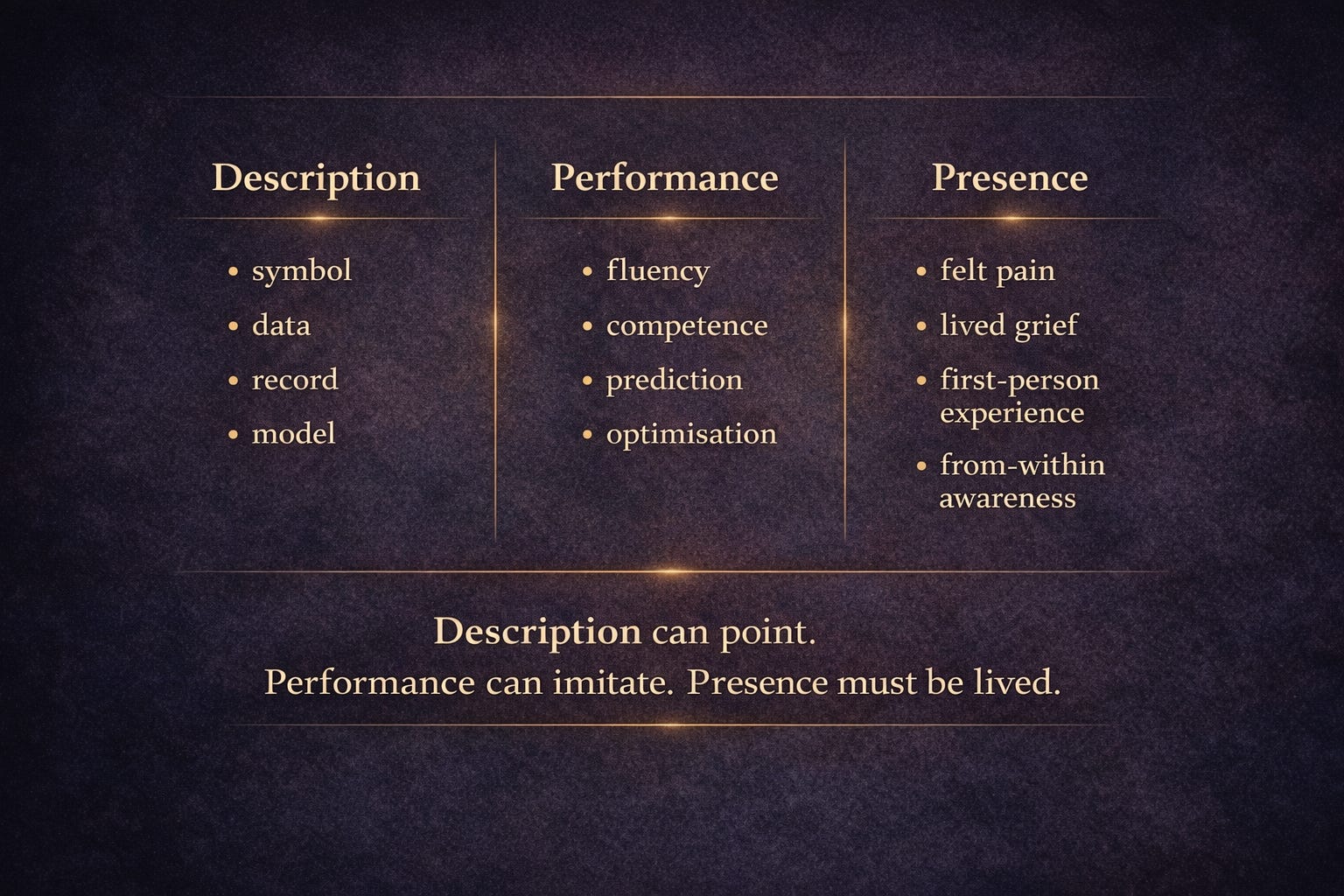
Describing pain is not the same as feeling it. A flawless account of grief is nowhere near the experience of grieving. A symbol can represent experience without ever becoming the experiencer.
Information can be shared. Consciousness must be lived uniquely, first-hand.
Intelligence Is Not Consciousness
The same confusion appears around intelligence. Intelligence and consciousness overlap, but they are not identical.
A system may be highly competent, adaptive, predictive, fluent, and strategically effective, yet unable to tell us whether anything is being lived from within.
Problem-solving, optimisation, prediction, and self-learning are still not consciousness, no matter how complex. None of those things proves subjectivity.
Intelligence describes what a system can do. Consciousness names what it is like to be.
Competence isn’t the same thing as presence.
A computer can outdo humans, a chess engine can beat any player, and a language model can speak more fluently than many people. But none of that proves there’s any inner experience or awareness.
Intelligence doesn’t solve the deeper riddle.
The distinction between intelligence and consciousness is easy to blur in a culture obsessed with output.
We’re surrounded by systems that reward performance, fluency, competence, scale, speed, and precision. Once something performs well enough, we start talking as though performance has become self-aware.
In RLMP, intelligence is better understood as the capacity to integrate novelty without losing coherence or structural integrity.

Simulation Is Not Life
The same applies to outward fluency more broadly. And it applies across scales, from personal and social systems to financial, biological, and technological ones.
A system can produce astonishingly convincing behaviour. It can imitate tone, mirror emotional structure, summarise, persuade, and seem reflective. It may reproduce many of the outward signs we associate with awareness. But none of that, by itself, demonstrates inner, felt meaning. It demonstrates patterned fluency.
We begin mistaking simulation for life, confusing signalling with sincerity, expression with experience, and behavioural complexity with subjectivity.
We start believing that if something looks enough like the real thing, it must be the real thing.
A system can reflect structure, but a conscious being inhabits it, feels through it, and experiences life from within it.
Replication Is Not Continuity
That distinction becomes even sharper when we come to continuity and identity. DNA can be copied. Memories can be recorded. Behaviour can be simulated. Neural states can, in principle, be modelled.
A pattern can be reproduced with extraordinary fidelity. None of that settles whether the same uninterrupted “I” continues. Replication preserves form. Continuation preserves the experiencer.
Imagine a perfect duplicate of you appeared tomorrow: same memories, same voice, same habits, same convictions. That other you could insist it was you, and others might believe it was you. But that would still not show that your present first-person continuity had moved into it.
Similarity is not continuation. Form is not the same as the living thread of being.
Contemporary thinking assumes that if the pattern is preserved, the person is preserved. But that assumption holds only if consciousness is the sort of thing that can be transferred, like information. And that has not been shown.
RLMP refuses to collapse lived continuity into a transferable pattern. The real question is not whether a form can be reproduced, but whether the living thread of first-person recognition truly continues.
Consciousness Beyond Brains
None of this denies biology. The brain shapes perception, memory, mood, language, temporal ordering, self-regulation, and the local stability of conscious life. Damage it, and the local organisation of experience changes.
RLMP interprets that dependency differently.
The brain is better understood as the interface through which awareness is organised, filtered, constrained, and stabilised in human form. That is an immense role—a necessary one for this kind of life.
But necessity isn’t a final explanation.
If a receiver is damaged, the signal becomes distorted or inaccessible through that device. That shows the device matters. It does not prove that the device generated the signal.
The point is to resist a philosophical inflation. Once we establish that the brain is indispensable for human consciousness as we know it, we slide too quickly into the stronger claim that the brain therefore fully explains consciousness.
Consciousness as the Foundational Structure (CFS)
In RLMP, consciousness is understood as the foundational structure of reality.
Unlike panpsychism, RLMP does not treat reality as built from tiny packets of consciousness. It understands consciousness as the relational, recursive structure through which reality becomes experienceable.
It names the deeper condition through which reality becomes experienceable at all.
Conscious beings are localised threads within a wider Recognition Field Matrix (RFM): centres of recursive recognition capable of registering self, other, memory, difference, need, and response.
The world does not arrive ready-made and then get observed by detached spectators. Reality is continually stitched into perceptual coherence through lived recognition.
Through recursive Recognition Loops, reality becomes lived from within. Behaviour, organisation, and information-processing describe only part of what is happening.
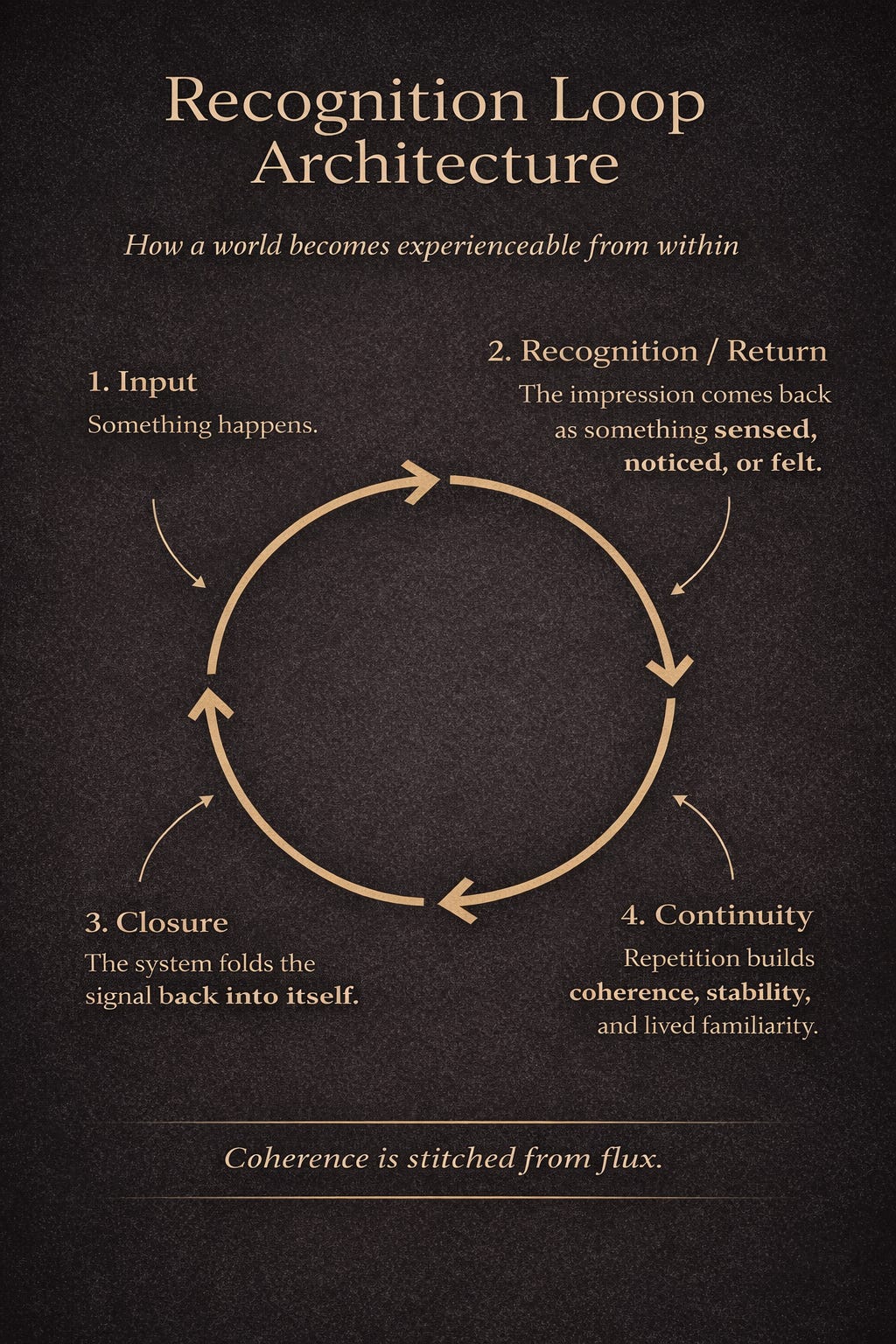
That is why relationships matter so profoundly in RLMP. Recognition is relational from the beginning. Consciousness is relational from the beginning. Relationships aren’t something added to reality later. Relationship is reality.
States of Conscious Experience
A world becomes experienceable through the closure of living loops: self and other, expectation and response, inner state and outer condition, continuity and change.
When those loops hold coherently, reality feels more stable, meaningful, integrated, and alive.
When they distort, consciousness narrows. Experience fragments. The world can begin to feel brittle, unreal, hostile, compulsive, or hollow.
So consciousness is not simply a light that switches on inside a system. It is the living continuity through which a world holds together from within.
The simplest evidence is ordinary experience. Awareness shifts mode all the time. Being awake is not the same as dreaming. Dreaming is not the same as meditating. Meditating is not the same as fainting. Anaesthesia is not the same as ordinary sleep.
Yet these shifts do not justify the conclusion that consciousness is identical to any one of those states.
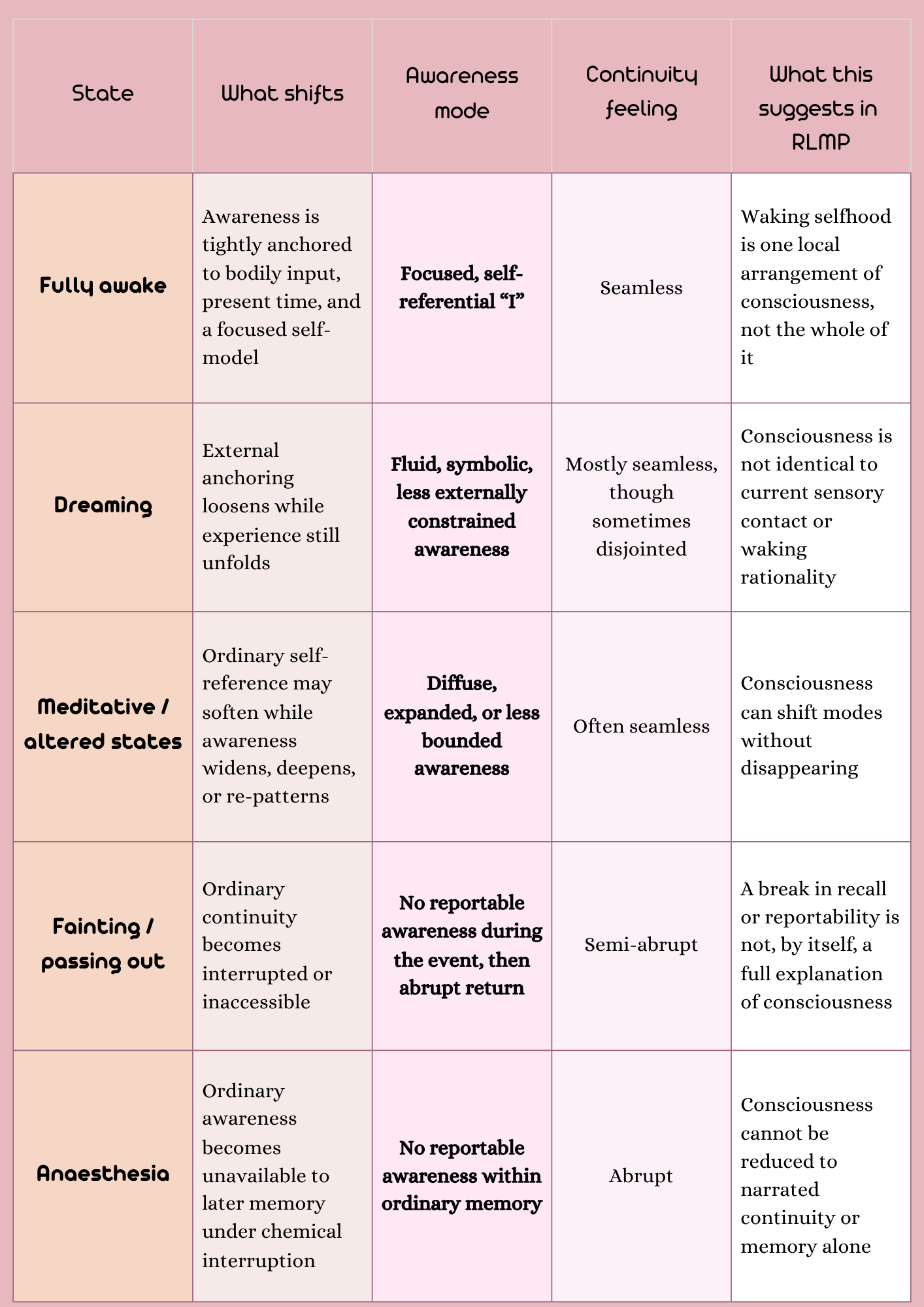
Across waking, dreaming, meditation, fainting, and anaesthesia, the same clue keeps returning: consciousness is not identical to a single state, a single self-model, or a single way of remembering.
In waking life, experience is tightly anchored to bodily and external input, organised around a focused self-model. In dreams, that anchoring loosens while experience still unfolds.
In meditation, the ordinary “I” can soften while awareness widens.
In fainting or anaesthesia, continuity may become inaccessible to later recall.
These shifts reveal that self-reference, memory, bodily anchoring, and reportability can all vary without giving us licence to conclude that consciousness itself has disappeared.
Once continuity is separated from memory, pattern, and surface form, the death question becomes unavoidable.
In RLMP, continuity beyond death is a structural implication of the framework. It’s the unavoidable, logical consequence of lived recognition.
Once consciousness is understood this way, the central question changes.
We are no longer asking only which mechanisms correlate with awareness, or which outputs resemble it convincingly.
We’re asking what kind of reality makes first-person continuity possible.
What kind of structure allows experience to be lived rather than described? What kind of recognition closes inwardly as presence?
That is where the Mirror Paradigm begins.
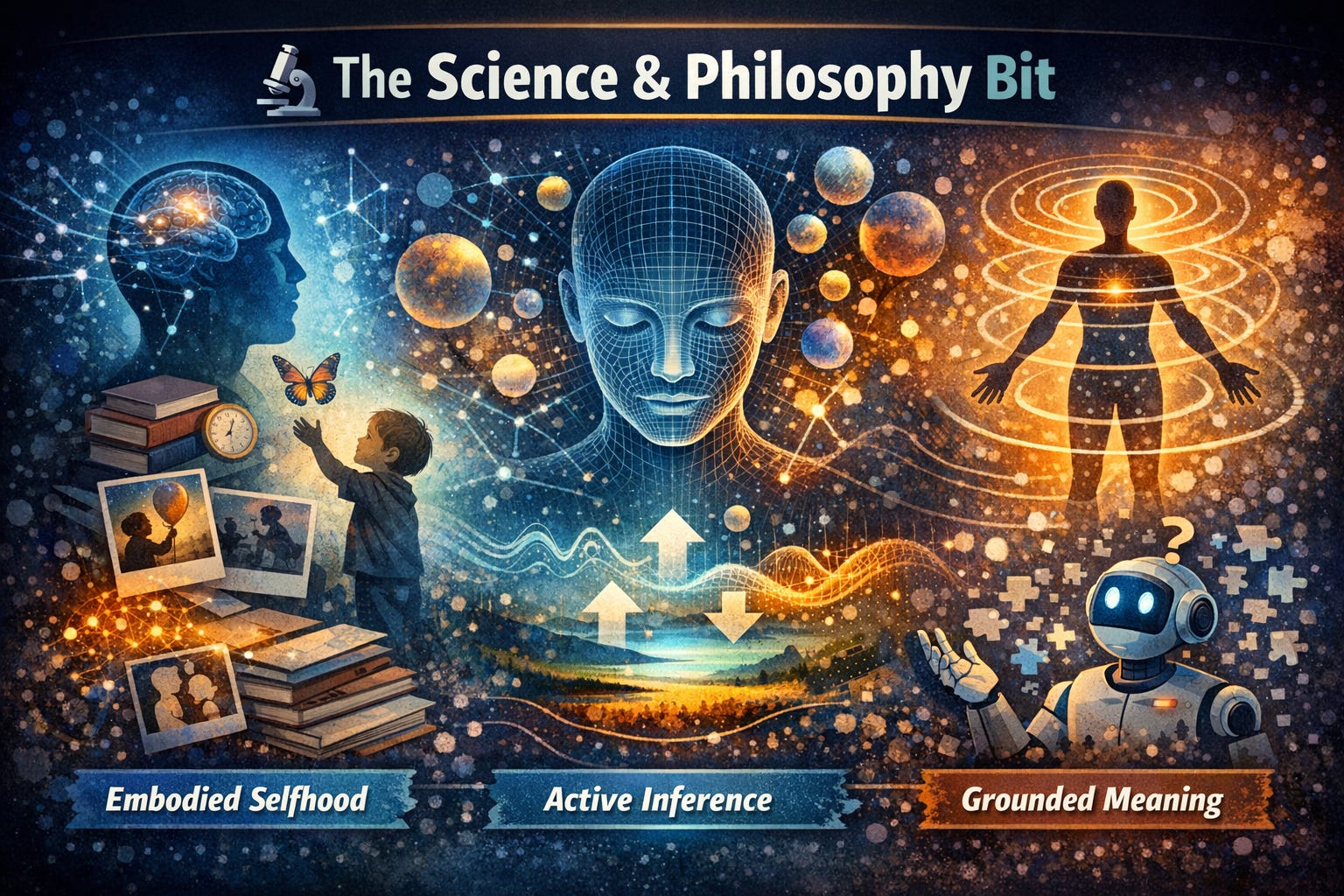
🔬 The Science & Philosophy Bit
Science is increasingly describing perception, selfhood, and meaning as active, embodied, and relational. RLMP takes it a step further.
Modern science has not solved the problem of consciousness through sheer accumulation of detail. But it has sharpened the outline.
Developmental psychology makes one point immediately clear: autobiographical memory develops gradually and arrives late.
Babies and young children plainly register and retain aspects of experience before the mature narrative self is in place, and childhood amnesia remains a real phenomenon in need of explanation.
That loosens one of the most common confusions in the discussion: the tendency to treat consciousness as though it were the autobiographical story we can later tell about ourselves.
Memory is clearly an integral part of consciousness. It helps organise experience, preserve continuity, and stabilise identity. Even so, awareness extends beyond what the story memory can later recover.
Predictive-processing research presses from another direction.
Perception now looks far less like passive recording and far more like active inference.
We continuously generate, update, and revise our expectations about the causes of sensations. Experience is an ongoing, hierarchical process of world-modelling, error-correction, and embodied adjustment.
The older picture of perception as simple input-reading has become much harder to defend.
Research on bodily selfhood sharpens the point further. Body ownership, self-location, and agency are sustained through multisensory and interoceptive integration. And they can be experimentally perturbed, weakened, or reorganised.
The feeling that your body belongs to you, that you occupy a specific place, and that you’re the one “doing things” isn’t quite as straightforward as it seems. It’s something that’s constantly maintained, surprisingly flexible, and perpetually shaped by your connections with the world around you.
Embodied selfhood is less of a fixed possession and more like an ongoing work in progress.
Embodied and grounded cognition place similar pressure on older accounts of meaning.
Across this research tradition, cognition increasingly appears as world-involving, action-shaped, and context-bound. Meaning takes form through sensation, movement, and relationship.
There are debates within the field, and not every embodied-cognition claim carries the same weight, but the larger direction is clear. Mind increasingly looks like lived engagement rather than detached symbol handling or abstract information-processing.
The symbol grounding problem brings the philosophical stakes into focus.
A formal system can manipulate symbols according to rules without establishing what those symbols mean to the system.
That’s one reason current debates around language models like ChatGPT are so important.
Text-trained systems can display astonishing fluency, yet grounding does not suddenly appear simply because the outputs become more fluent or convincing.
Language can carry rich semantic structure while still leaving the deeper questions untouched: lived meaning, first-person understanding, and what it’s like to be in the world.
This doesn’t fully prove RLMP, and that’s not the claim. The point is more specific, and its precision makes it stronger. A minimal, matter-first view of consciousness explains less than it admits.
Modern science increasingly portrays perception, memory, selfhood, and meaning as active, dynamic, embodied, and relational.
Science is becoming better at describing the conditions under which conscious life is organised: how memory develops, how perception is constructed, how selfhood is maintained, and why meaning cannot be reduced to formal manipulation alone.
Yet describing the architecture around consciousness still falls short of explaining why any of it is lived from within.
That gap is why the question of consciousness remains unresolved, why reduction consistently arrives prematurely, and why the Mirror Paradigm regards lived experience as primary rather than as an awkward, inexplicable leftover.

🧭 What It Means For You
Your awareness is deeper than your current self-description. That is structural, not motivational.
Memory gaps do not mean the absence of conscious awareness.
Emotional intensity (or suppression) does not mean irrationality.
Confusion does not mean there is no pattern.
Much of what shapes your conscious life was formed before you could narrate it. And it continues to operate beneath whatever story you currently tell about yourself, others and the world.
Your triggers have a patterned history. So do your reflex interpretations. So does your sense of what feels safe, real, familiar, possible, impossible, alive, dead, meaningful, threatening, beautiful, or true.
Modern culture trains us to confuse consciousness with whatever is most legible on the surface: confidence, fluency, stability, productivity, self-explanation, outward coherence.
If you cannot explain yourself neatly, regulate yourself perfectly, or present a polished narrative, you are encouraged to believe something has gone seriously wrong at the level of your being. That conclusion is highly unreliable—usually false.
Your narrated self is only one local arrangement within consciousness.
This is significant because the version of yourself that can presently be narrated, defended, or explained is not the entirety of who you are.
There is more to your awareness than the version of you that can currently be named, remembered, defended, or explained.
This should also make you more serious about other people.
Others are not merely bodies performing roles or systems generating outputs. They are centres of lived recognition trying to hold a world together from within.
Every person you meet carries a structure of memory, sensitivity, fear, interpretation, expectation, and meaning that exceeds what is visible on the surface.
That does not require dereliction of accountability or sentimentality. It requires precision.
The more clearly you understand consciousness, the harder it becomes to reduce people to histories, genetics, performance, utility, ideology, status, diagnosis, or function.
A person is never only what they display. Something is being lived within them, through them, whether or not we can observe it.
The same insight should make you more cautious around deeply embedded systems (including people) that mimic coherence without presence.
Smoothness is not depth. Fluency is not wisdom. Precision is not coherence.
A polished surface can be convincing while remaining empty of lived interiority.
Cultures that lose the distinction between performance and presence eventually begin treating people as machines and machines as people.
The confusion reaches into our relationships, education, technology, therapy, politics, and everyday life. It shapes what—and who—we reward, trust, dismiss, and fail to protect.
You are not an output to optimise, a performance to polish, a memory archive to manage, or a brain-state to explain away.
You are a lived continuity: a centre from which experience happens, a being through whom reality appears from within.
That is what modern culture keeps teaching us to forget.

🪞 Final Reflections
We keep trying to explain consciousness by describing everything around it—brains, signals, memories, information, intelligence, computation, behaviour, prediction, performance.
While relevant, none reach the central fact that there is something it is like to be here. To be yourself.
Consciousness cannot be cleanly reduced to matter, memory, information, intelligence, or computation.
So, what is consciousness?
It is the lived continuity of recognition through which self, other, and world become experienceable from within.
The brain helps organise it. Memory helps narrate parts of it. Information helps describe aspects of it. Intelligence helps manage within it. Performance can imitate some of its signs. None of those, by themselves, is consciousness itself.
Once that distinction is clear, a great deal of confusion starts to fall away.
Life is no longer mistaken for a set of transactional functions. Identity is no longer confused with the whole of awareness.
Fluent output is no longer taken as proof of inner life.
Reality stops looking like the ghost in the machine, viewed from nowhere. It re-emerges as something lived.
To ask what consciousness is is ultimately to ask how anything becomes real from the inside out.
That question sits beneath the question of who you are, what other people are, whether machines could ever have minds, what continues after death, and what kind of reality this must be for experience to exist.
Consciousness is not exhausted by complex matter, memory, personal narrative, computation, or outward behaviour. It runs deeper than any of them.
Consciousness is the ongoing continuity of recognition through which self, other, and world become experienceable within a shared field matrix.
That is where the Mirror Paradigm begins.
This article sits between What Is Recursion? and What Is Death? in the Philosophical World series. If you’d like the full arc, read those next.
📚 Sources
This article draws on work in neuroscience, developmental psychology, embodied cognition, and philosophy of mind, especially the following sources.
Seth, A. K., & Bayne, T. (2022). Theories of consciousness. Nature Reviews Neuroscience, 23(7), 439–452.
Mashour, G. A., Roelfsema, P., Changeux, J.-P., & Dehaene, S. (2020). Conscious Processing and the Global Neuronal Workspace Hypothesis. Neuron, 105(5), 776–798.
Cogitate Consortium, Ferrante, O., Gorska-Klimowska, U., Henin, S., Hirschhorn, R., Khalaf, A., et al. (2025). Adversarial testing of global neuronal workspace and integrated information theories of consciousness. Nature, 642(8066), 133–142.
Nelson, K., & Fivush, R. (2004). The emergence of autobiographical memory: A socio-cultural developmental theory. Psychological Review, 111(2), 486–511.
Fivush, R. (2011). The development of autobiographical memory. Annual Review of Psychology, 62, 559–582.
Bauer, P. J., & Larkina, M. (2014). The onset of childhood amnesia in childhood: A prospective investigation of the course and determinants of forgetting of early-life events. Memory, 22(8), 907–924.
Friston, K. (2012). Prediction, perception and agency. International Journal of Psychophysiology, 83(2), 248–252.
Blanke, O., Slater, M., & Serino, A. (2015). Behavioural, neural, and computational principles of bodily self-consciousness. Neuron, 88(1), 145–166.
Barsalou, L. W. (2008). Grounded cognition. Annual Review of Psychology, 59, 617–645.
Harnad, S. (1990). The symbol grounding problem. Physica D: Nonlinear Phenomena, 42, 335–346.
Pavlick, E. (2023). Symbols and grounding in large language models. Philosophical Transactions of the Royal Society A, 381(2251), 20220041.
📔 Glossary
Consciousness: In RLMP, the lived continuity of recognition through which a world appears from within.
Recognition: The process through which difference becomes experienceable, meaningful, and capable of re-entry.
Narrated self: The autobiographical, language-shaped, socially legible version of “me” that forms within consciousness rather than generating it.
Selfhood: The locally organised sense of self shaped through memory, embodiment, relationship, expectation, and repeated recognition over time.
Autobiographical memory: The memory system that supports personal history, self-narrative, and replayable episodes of one’s life.
Recursive recognition loops: Repeating cycles of recognition through which continuity, coherence, and lived experience are stitched and stabilised.
Loop-closure: The successful completion of a recognition cycle, allowing continuity and stability rather than fragmentation.
Recognition Field Matrix (RFM): The shared recognition ecology within which self, other, and world become stably experienceable.
Consciousness as the Foundational Structure (CFS): The RLMP view that consciousness is not a late by-product of matter, but the deeper structuring condition through which reality becomes experienceable at all.
From-within: The lived first-person perspective through which reality is experienced internally rather than merely described externally.
Presence: The fact that something is being experienced from within; lived first-person awareness.
First-person continuity: The uninterrupted lived thread of experience that makes an experiencer the same centre of awareness across time, despite changes in content, memory, or state.
Performance: The outward display or simulation of coherent behaviour, language, emotion, or awareness.
Replication: The reproduction of form, structure, or pattern.
Continuation: The persistence of the experiencer itself, rather than the mere copying of its structure.
Interface: In this article, the role of the brain as organiser, filter, and stabiliser of conscious life in human form, without being assumed to be the final origin of consciousness
Good.
I like the way you grapple with the apparent poverty of language. In which "conscious" could mean "not comastose," "explicit" (in a cognitive sense) or the opposite of subconscious (in a psychoanalytic sense).
To the extent we feel something else is going on, the challenge is to operationally define it. And while I have some nits to pick, you've taken a good swipe at it. Beats the snot out of anything I've seen in the neurological literature, I'll say that.
Are you familiar with quasicrystals?